寄送至:
rsgtaipei.tat@gmail.com
主旨:欲由XXX品牌大使推薦參與 RSG Taipei 2026


RSG Taipei 2026: When Scrum Walks Into the CEO’s Decision Room
Most agile conferences end with a photo album and a vague feeling that "it went well." RSG Taipei 2026 ended with 174 independent surveys and an NPS of 71, with 51.7% of respondents at management level or above — not a coincidence, but the scorecard from the only Regional Scrum Gathering in the world built entirely around “CEO decision-making” as its core positioning. This gathering replaced lectures with facilitation, ticket sales with referrals, and scale with decision-making depth, raising agile’s ceiling from the team to the boardroom. What actually stalls a company was never a shortage of method — it’s whether the decision-maker is willing to lay judgment calls out for the team to see. This article records how the gathering was designed, how far the volunteers pushed self-organization, and the one question behind 174 surveys that every company should be asking itself.
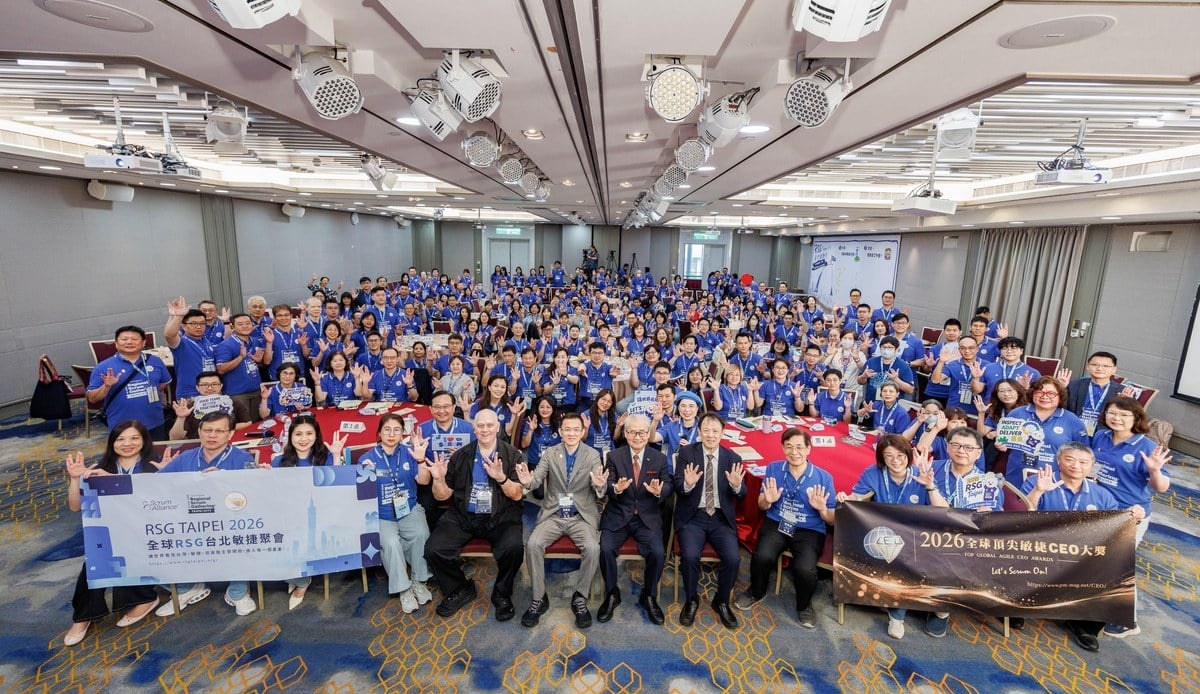
RSG TAIPEI 2026 | By Roger Chou | Taiwan’s First International Agile Ambassador Date: 2026/08/18
Every RSG has one person who must answer the same question: who is this gathering for, what will it give up, and what will it hold onto. That role isn’t the chair — it’s the Product Owner, the person who orders the backlog, calls the direction, and owns the outcome. For RSG Taipei 2026, that Product Owner was me.
For this edition, I kept exactly one item at the top of the backlog: get decision-makers to walk in themselves — to be facilitated themselves, to be challenged themselves — instead of sitting in the audience listening to someone else talk. When I first proposed this vision two years ago, not everyone in the community believed it. Why would a CEO give up a full day to sit in a room of strangers and lay their hardest problems on the table?
But it’s exactly that seemingly impossible vision that made RSG Taipei 2026 the only Regional Scrum Gathering in the world built entirely around a “CEO-first” positioning, with facilitation — not lectures — running through the whole day.
1. A Room That’s 70% CEOs: What That Actually Means
233 people requested tickets, 95% showed up — neither number would surprise anyone who’s been to an RSG. What’s genuinely surprising is the next one: of the 174 post-event survey responses, 51.7% (90 people) self-identified as holding some level of management title.
If you’ve been to an RSG — London, Denver, anywhere — you know who usually fills the room: engineers, Product Owners, Scrum Masters, practitioners who genuinely believe in agile and are fighting for it inside their teams. That’s Scrum’s most precious soil, and that will never change, nor should it. But on August 15, 2026, the room in Taipei wasn’t filled with that crowd. It was filled with people who usually only show up in boardrooms, earnings calls, and the VIP table at the company banquet. They chose to give an entire day to Scrum.
What actually stalls a company was never a shortage of agile methods — it’s whether anyone is willing to own the judgment call, and its consequences, under uncertainty. For the past twenty years, the core problem Scrum solved was “how does the team deliver faster and more accurately” — important enough that an entire industry built its methodology, certification system, and coaching ecosystem around it. But that question has a blind spot no one has ever answered head-on: if the team is already agile, and the decision-makers above them are still running quarterly meetings, linear sign-offs, and top-down calls, where’s the ceiling on agility?
The answer is uncomfortable: the ceiling isn’t the team. It’s the decision-makers.
Dr. Roger Chou — Taiwan’s first International Agile Ambassador and newly elected Scrum Alliance Global Board Director — said something at the awards ceremony that explains this 51.7% better than any statistic could:
Roger’s Take: Just like in the AI era, it’s not only engineers who write code anymore — executives use AI to make decisions, but without an agile mindset, no decision outpaces being replaced.
2. The Only RSG in the World Designed This Way
This may be the only Regional Scrum Gathering in the world explicitly designed around CEOs and senior corporate decision-makers as its core audience — not a meetup for agile enthusiasts, and not team-level content simply repackaged for an executive audience. That positioning drove three decisions in the event design, each one the reverse of how every other RSG in the world does it.
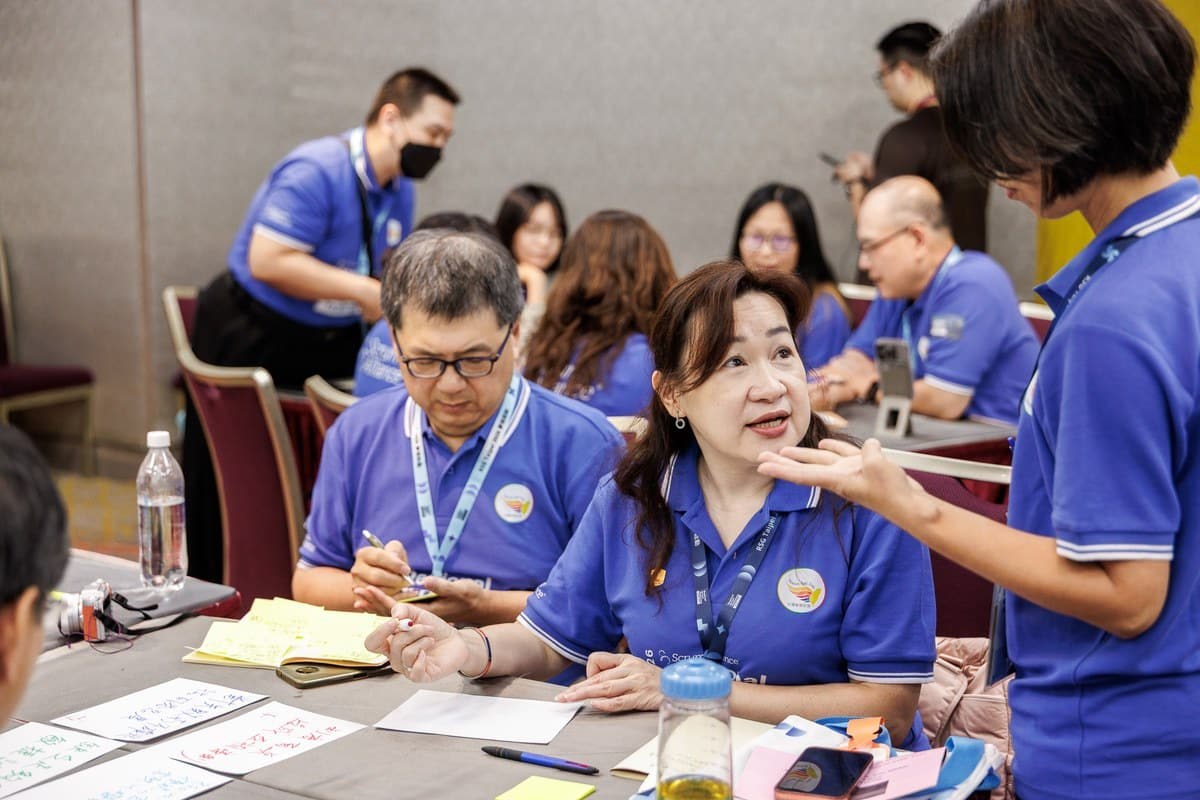
No lectures — facilitation instead. The center of the day isn’t sitting in the audience listening to someone talk; it’s getting decision-makers to talk to each other, to challenge each other’s real problems. “A lecture is me sitting in the audience listening to someone better than me talk. Facilitation is me talking — and everyone talking to each other.”
No ticket sales — referral plus a deposit instead. In the end, 20 CEO brand ambassadors referred attendees in; participants paid a deposit, refunded in full after full attendance, with the cost covered by the person who referred them. “If an event is free, the audience treats it as optional. I wanted participation that people chose for themselves.” Behind this design sits the piece of the agile spirit most often overlooked: self-organization and self-accountability.
And the last decision — the most counterintuitive of all — was choosing to shrink the scale in order to grow the weight of the decisions in the room. Honestly, I hesitated over this myself at first. RSG Taipei’s first edition in 2022 set a record with 888 registrants, the highest attendance in RSG history worldwide; 2024 broke its own record again with 1,111. Two editions, two world records — Taiwan is the only city to have rewritten the RSG attendance record twice in a row. Most events, after setting a record, look for a way to go even bigger. RSG Taipei 2026 did the opposite: it narrowed down to 150 referral-only seats, no longer competing on headcount, but on whether agile had genuinely reached the room where decisions get made.
Scale is a metric anyone can copy. Decision-making depth is not.
3. How a Room of 200 Was Facilitated Into Telling the Truth
What a gathering rehearses isn’t its run of show — it’s the depth of its conversations.
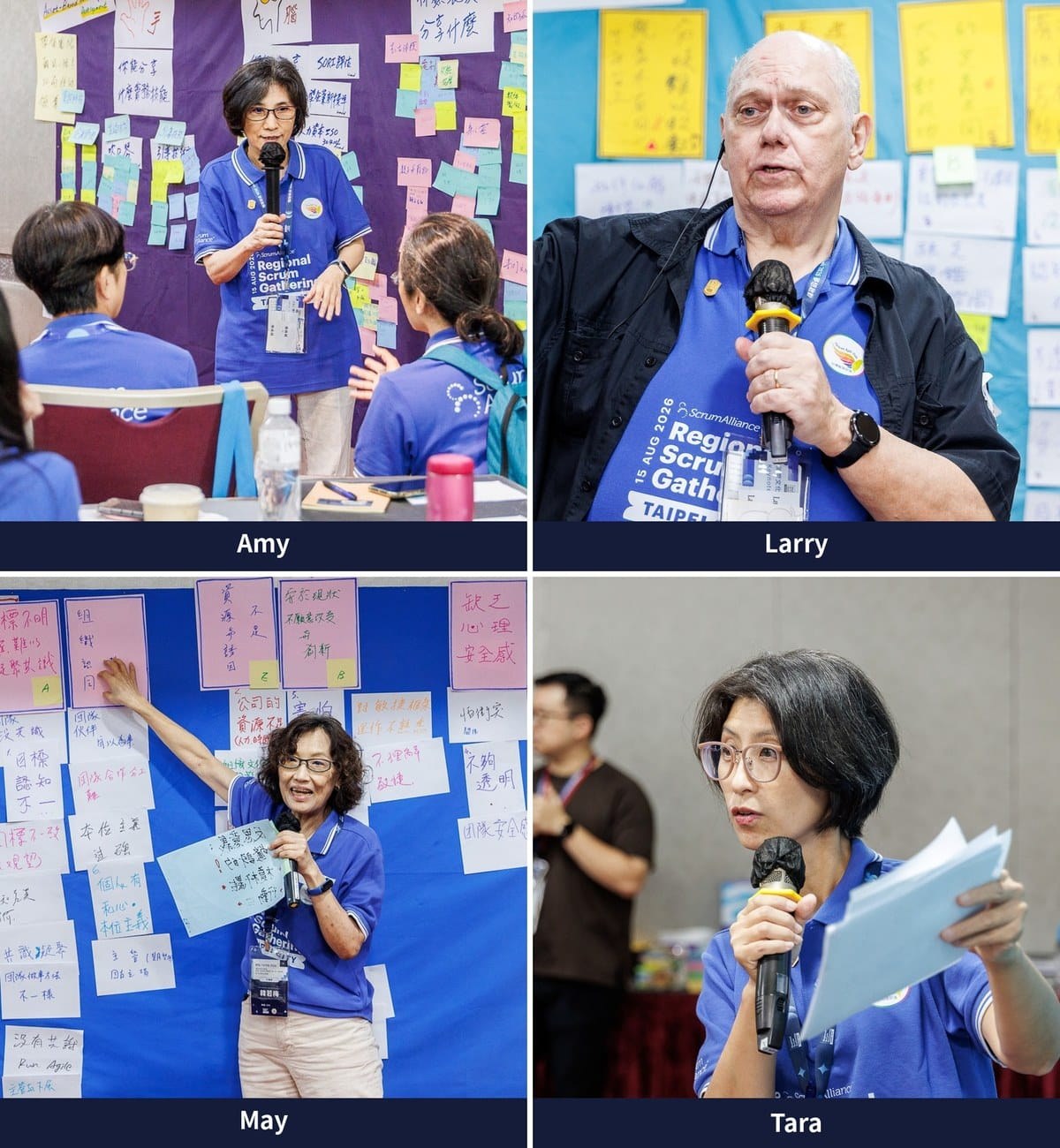
Thirty minutes before the program began, over 200 people did one thing: a nine-square check-in, where everyone was required to walk up to nine strangers and exchange a line. In that first hour, no one could just chat with people they already knew — that was deliberate, forcing everyone out of their comfort zone first.
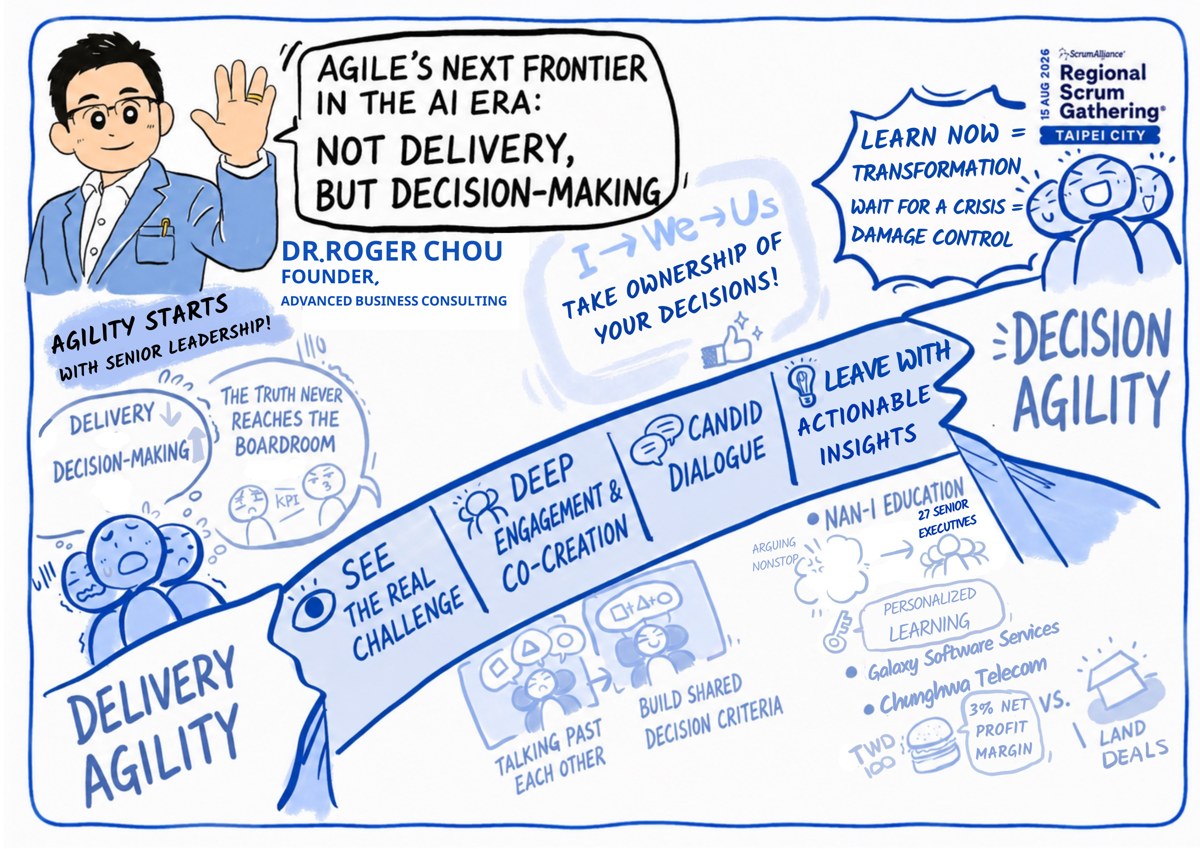
Facilitation ran on two tracks across three sessions, each with its own job: the first surfaced real challenges, pushing every attendee to lay out where their own organization was stuck; the second went deep into co-creation, having decision-makers from different industries pull apart each other’s problems; the third opened up honest dialogue, distilling the morning’s challenges and co-creation into a single line worth carrying home.
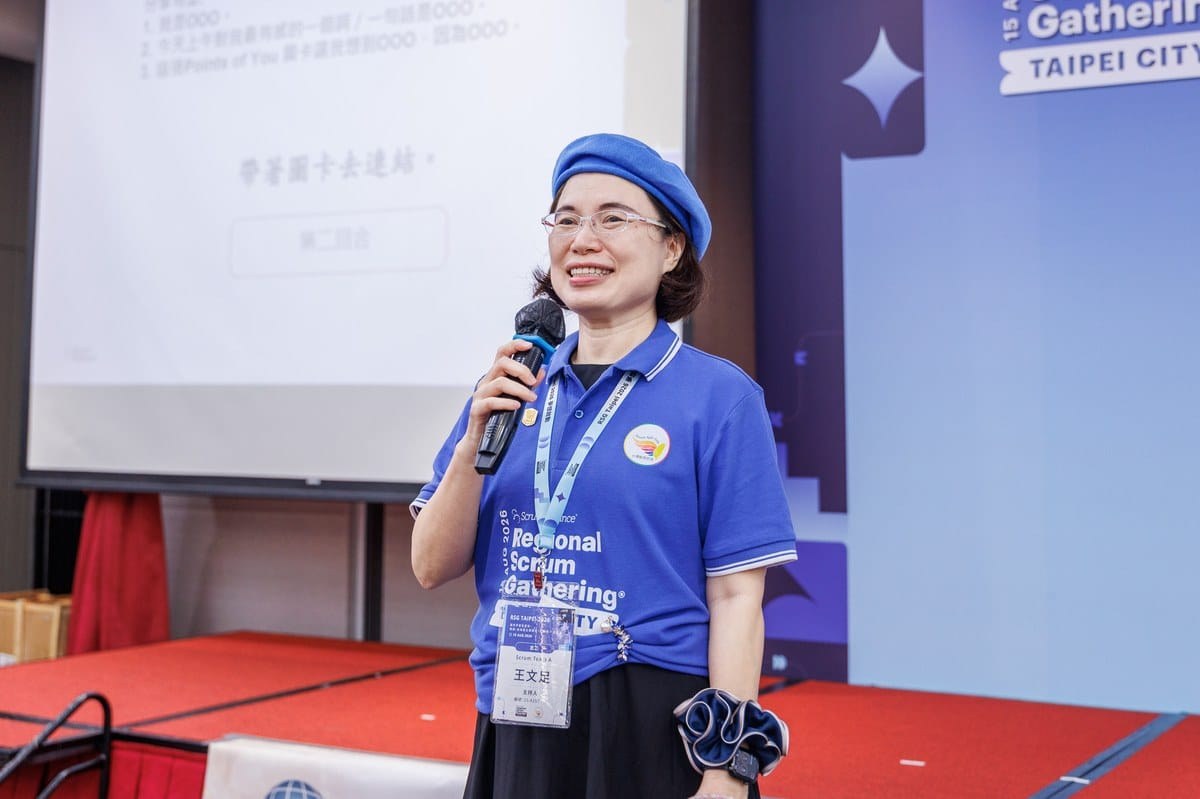
Midday’s deep-dive exchange was handed to host Wang Wen-tsu. Using Points of You facilitation cards, she ran the whole room through a “grand reshuffle” — people who had been sitting at the same table were split up and re-paired, each required to find at least two attendees they didn’t already know and complete a genuinely deep one-on-one conversation.
Closing the day fell to Lawrence Philbrook, an internationally renowned facilitator and IAF Hall of Fame member. Using a modified World Café format, he had all 200 people think through the same question at once: what did today’s facilitation spark in you? What are you taking home?
No other RSG has designed “facilitation” itself down to this level of granularity.
4. 22 Hours 36 Minutes, 3 Working Days, 6 Calendar Days: Speed Is the Most Honest Evidence
When an event calls itself agile, that usually just means it ran an event with an “agile” theme. RSG Taipei 2026 chose to prove it a different way: by turning every key milestone into a number on a timeline, and letting the timeline speak for itself.
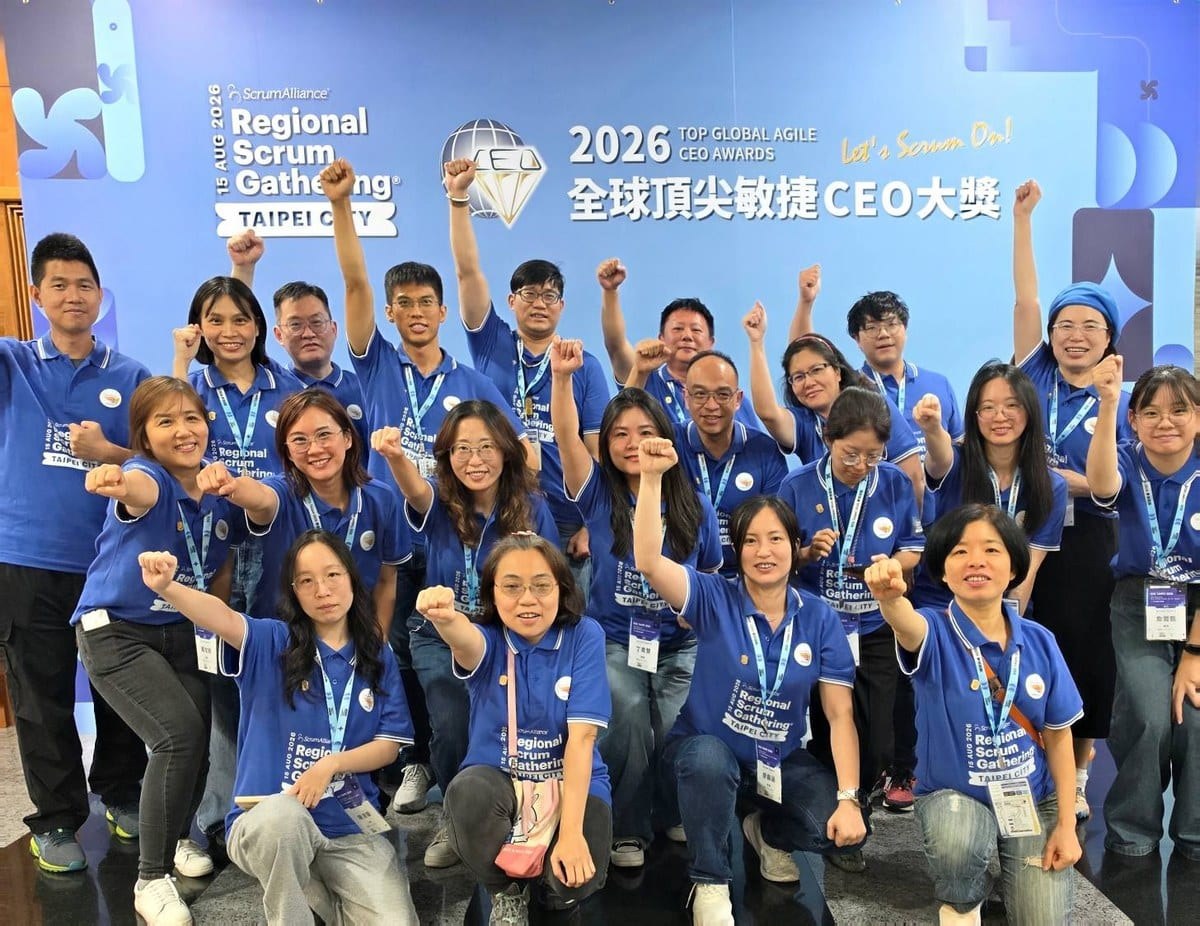
The first number belongs to the volunteers. The volunteer-skills survey went live at midnight, June 23, 2026 — two Scrum Teams, 20 seats. At 22:07 I had just posted in the group chat, “Only one seat left.” By 22:36, all 20 seats were filled. From posting to full: 22 hours 36 minutes.
The funding number moved even faster. The sponsorship prospectus went out at noon on January 16. Within 3 working days, not only was the original quota filled, community response actually exceeded expectations — 20 companies stepped forward on their own to become brand ambassadors, each self-funding at least NT$20,000. No one had to be talked into sponsoring; they raced to become Givers.
As for the audience, 150 seats opened for ticket requests — no ads, no paid promotion, purely word of mouth through the community, with progress posted publicly every day. All 150 were claimed within 6 calendar days.
Put these three numbers together and they’re really saying the same thing: when an organization has truly internalized self-organization, self-accountability, and transparency down to the bone, the speed at which it gets things done shows up in a way that surprises even the organizer.
5. One Letter, One 28-Page Deck: Bringing Taiwan’s Decision-Making Mindset Into the Same Room
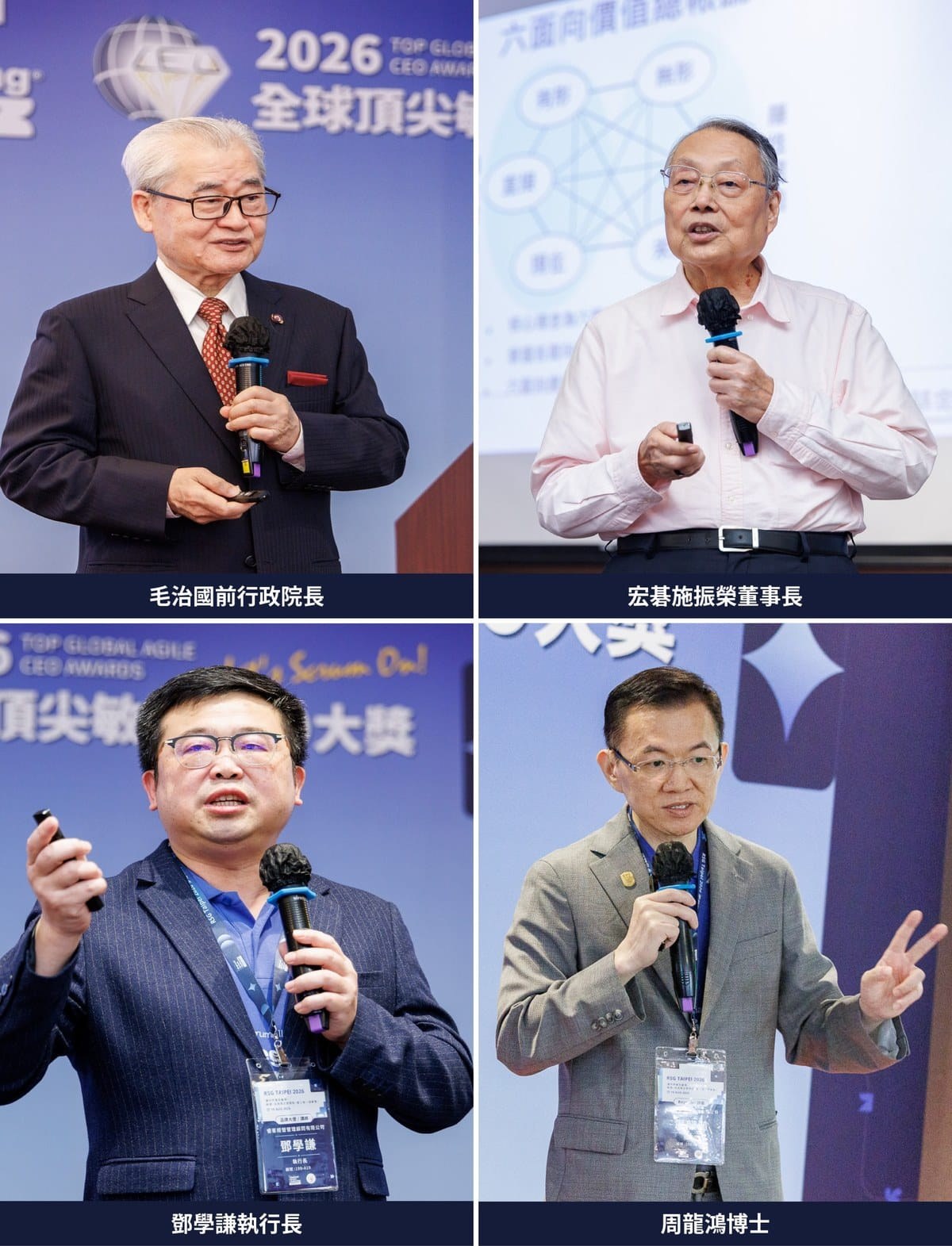
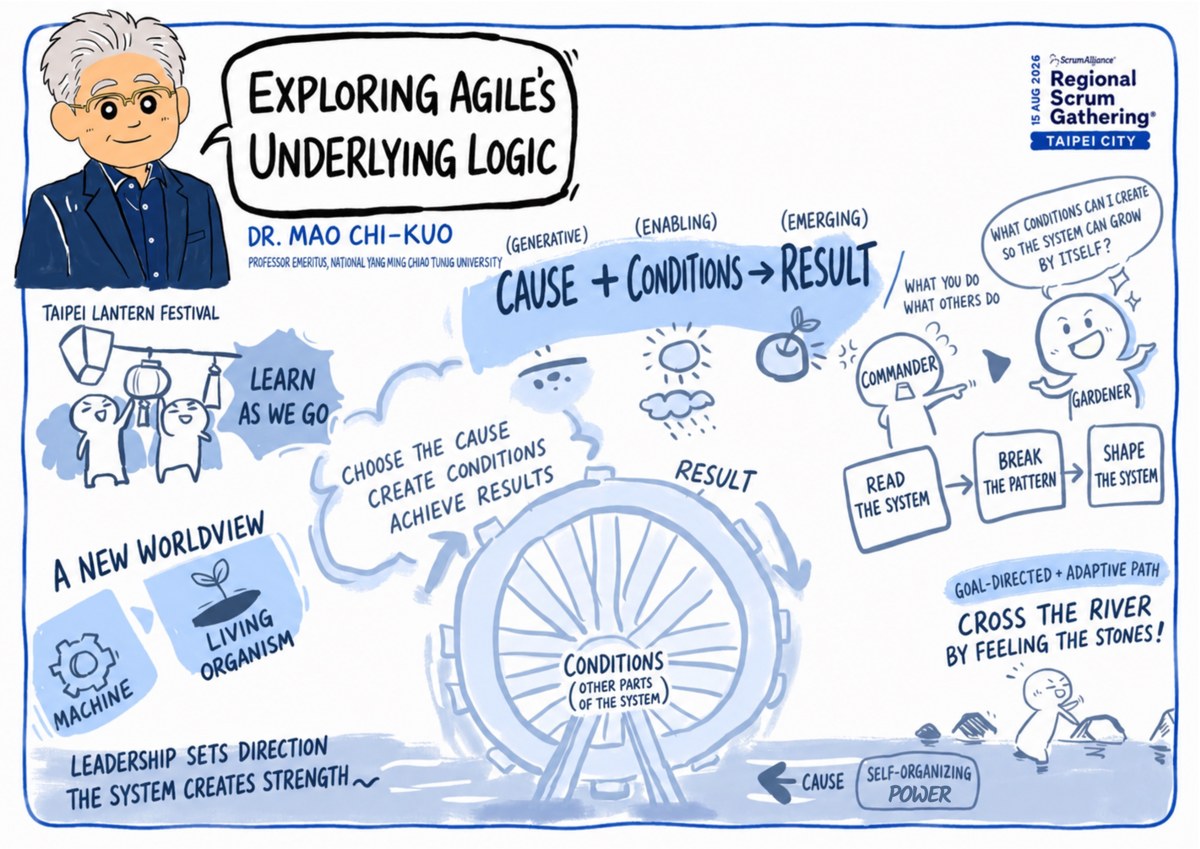
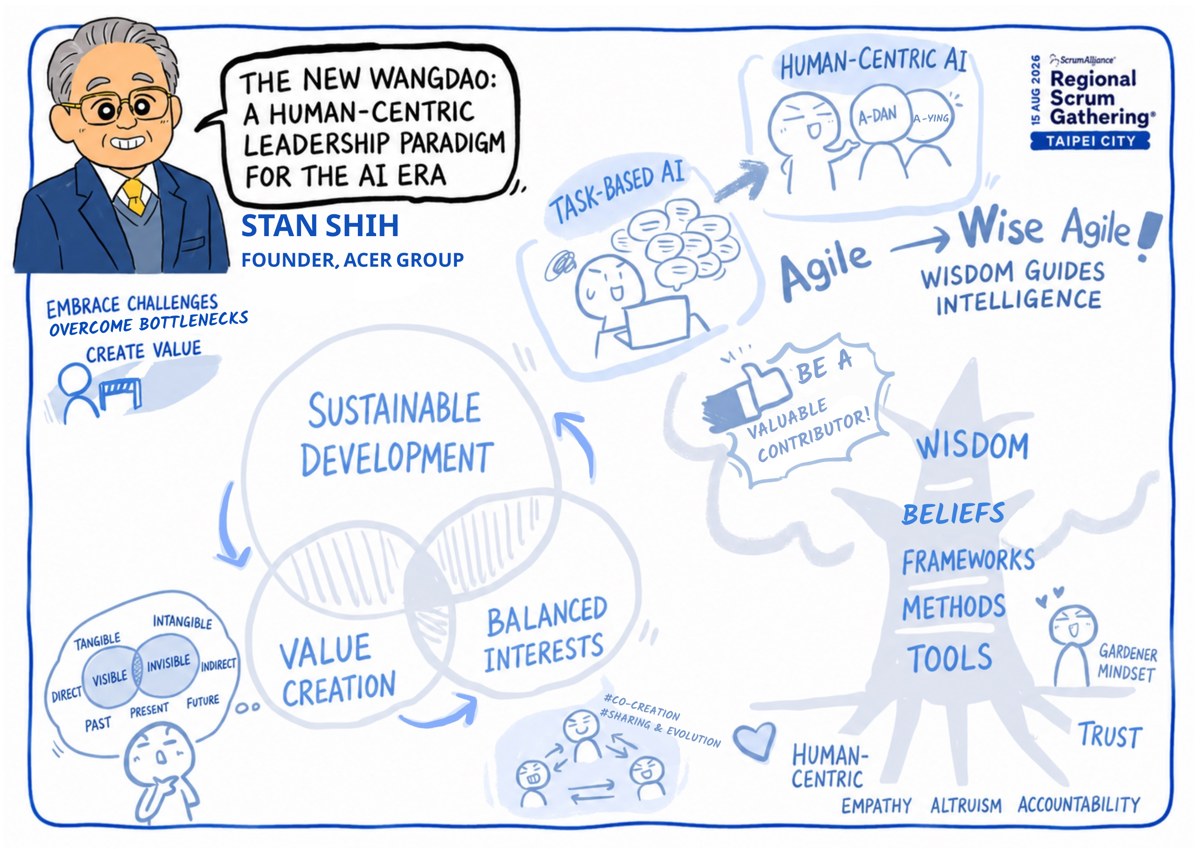
Any positioning needs evidence, and RSG Taipei 2026’s evidence is the people it brought to the stage. This year’s keynote lineup spanned industry, government, and academia: I anchored the opening myself, followed by former Premier Mao Chi-kuo, Chairman Stan Shih (founder of the Acer Group), and Lawrence Philbrook, internationally renowned facilitator and IAF Hall of Fame member, closing the day.
I didn’t originally know Chairman Stan Shih. It took a letter and a customized 28-page deck to make the case — why RSG needed him, why the industry needed him — before this heavyweight speaker agreed to join. That detail proves something no marketing language ever could: getting a CEO to give up a full day was never about the scale of the event. It was about whether you’d actually thought through what agile has to do with their world.
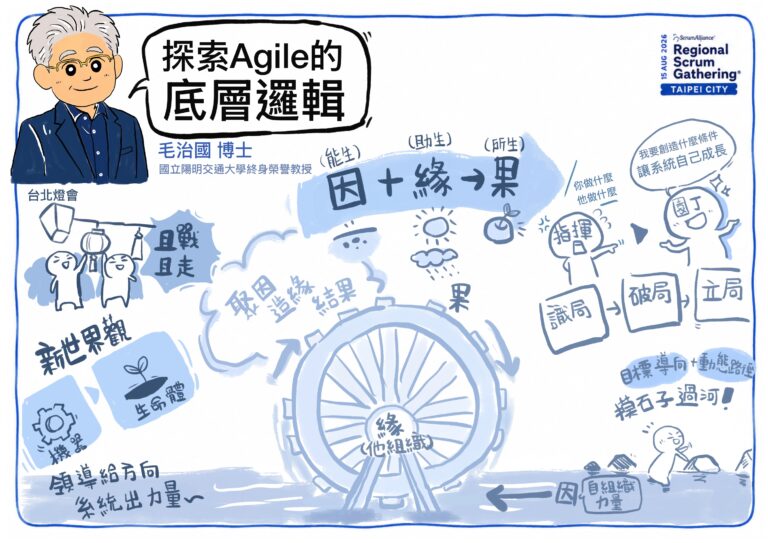
Onstage, Dr. Mao Chi-kuo sketched out a “waterwheel theory”: the flowing river is the force of self-organization, the man-made waterwheel is leadership and governance structure, and only when cause meets condition can the water climb against its own current — placing agile inside a systems-thinking framework older than management theory itself. Chairman Stan Shih distilled Taiwan’s most valuable management export into three words: the Kingly Way — creating value, balancing interests, and pursuing sustainability.
A decision-maker who once stood at the highest level of Taiwan’s governance, and a founder who led his company through multiple paradigm shifts, speaking two entirely different languages, said the exact same thing: anyone can buy the tools. No one can do your mindset shift for you.
6. What No One Sees Is the Most Honest Evidence an Agile Team Can Give
The most honest evidence of an agile gathering isn’t the speaker lineup on stage. It’s in the places, backstage, that no one ever sees.
Command lead Lei Chia-jung single-handedly carried Zoom links, ticketing backend, and outbound correspondence through the entire preparation period. The night before the final rehearsal, his brake caliper pad literally fell off as he took an exit ramp. He dealt with it and still got online for the meeting on time, then sent out the next day’s Sprint notice as usual, as if nothing had happened. Late one night in the group chat, this is how he described himself:
“This gathering came together because volunteers self-organized — I just pulled information together… nothing worth mentioning.”
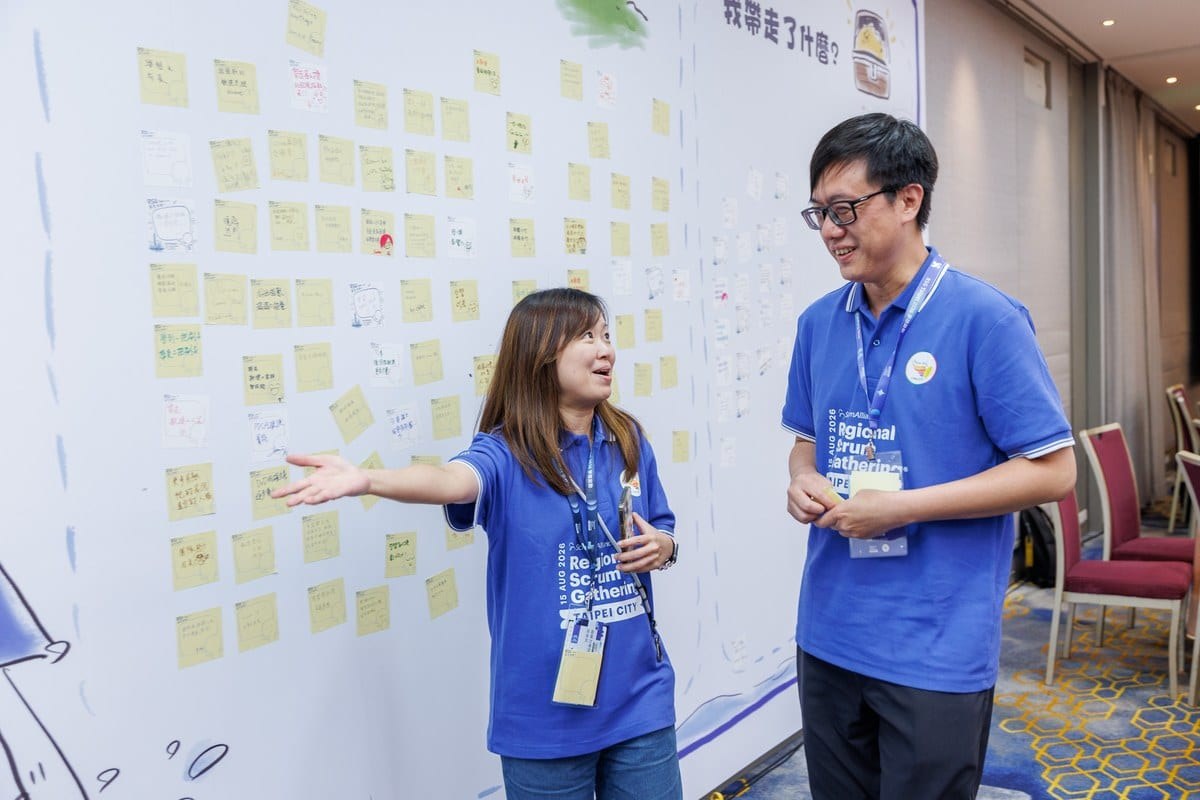
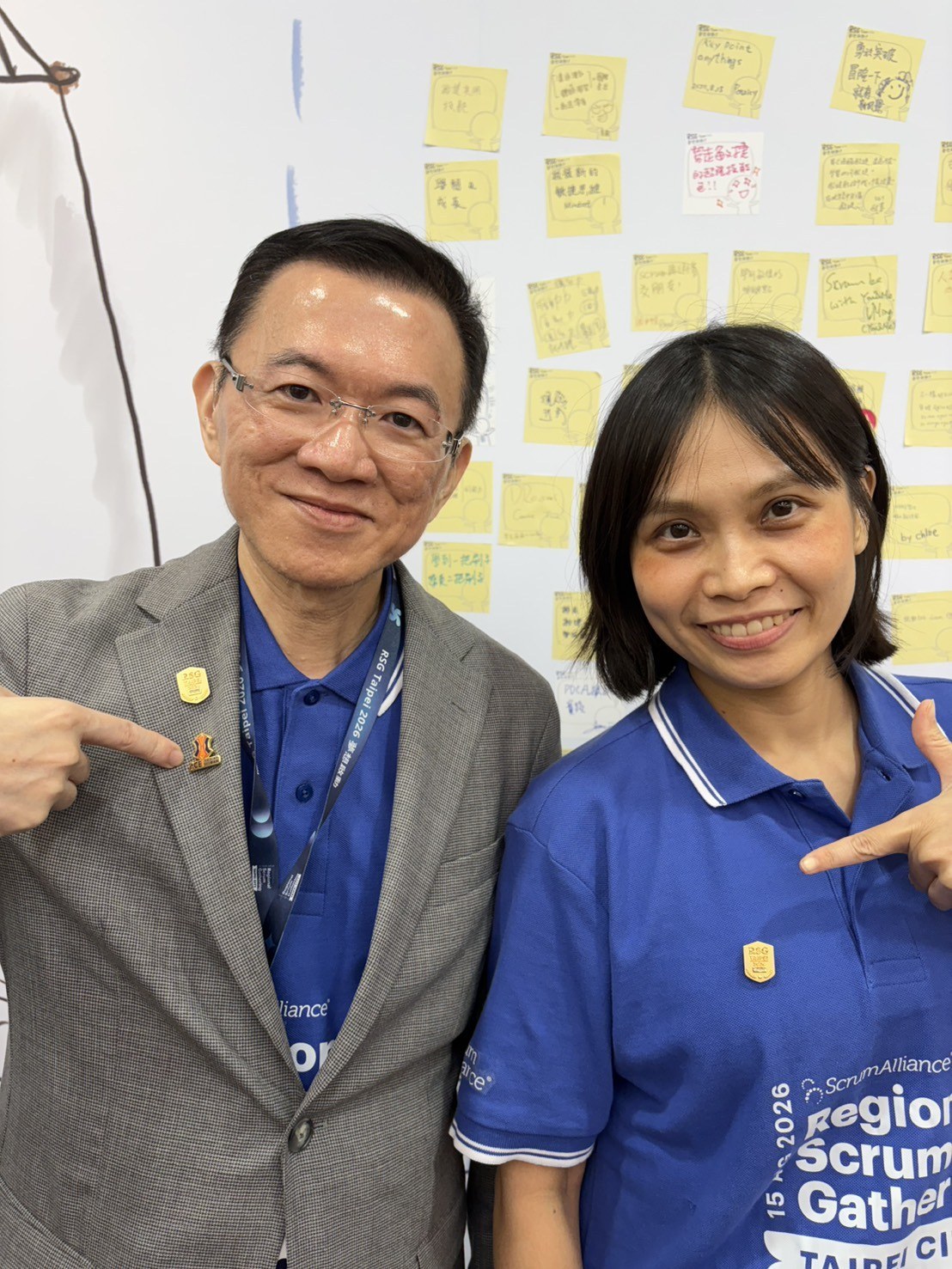
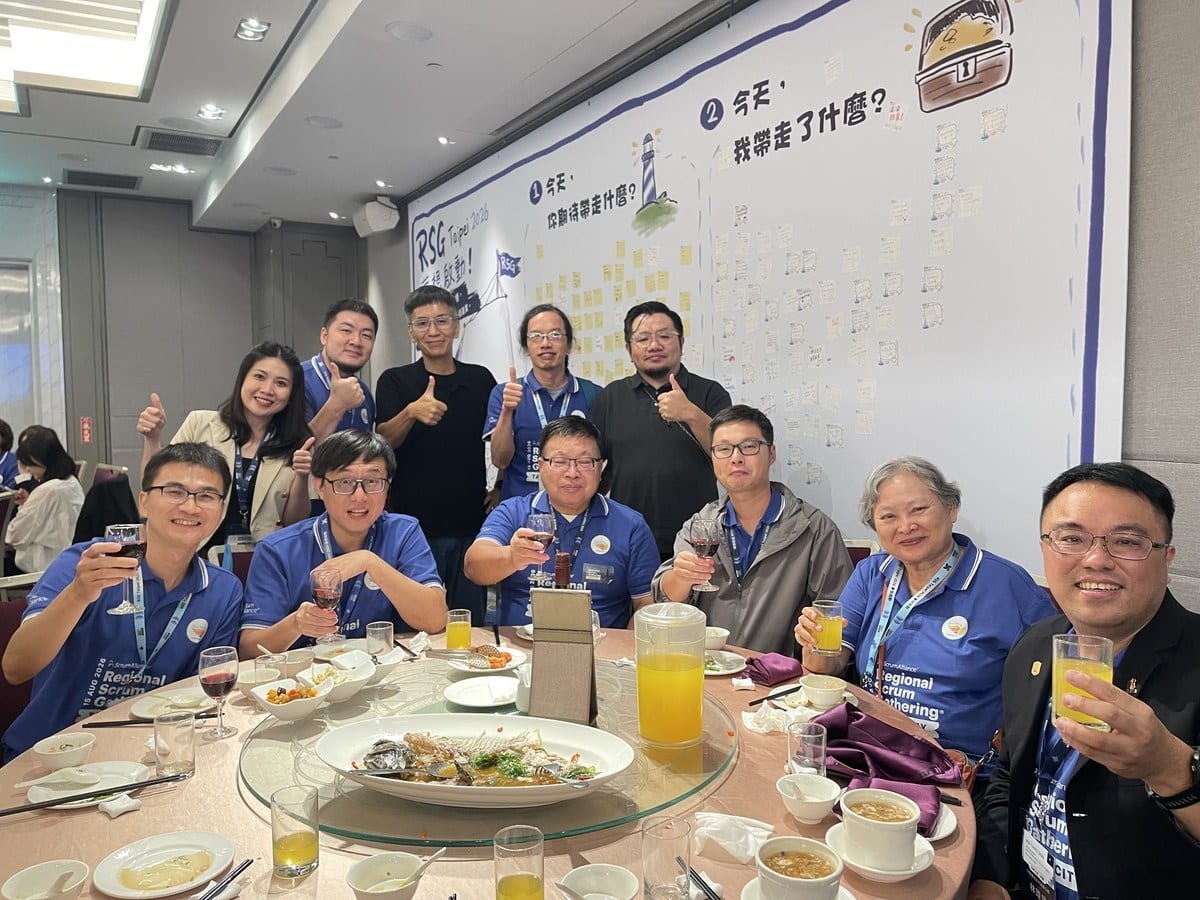
Volunteer Ya-chun, stuck on an outlying island and unable to visit the venue in person, still single-handedly carried the design of the on-site interactive wall — from the proposal, to the group vote, to finding an illustrator to hand-draw the final version. The day it was finished, I replied with three words: “That’s professional.” On the day of the event, that wall really was covered, by hand, in sticky notes from over 200 attendees.
The night before the event, Lei Chia-jung and Chia-chi took it upon themselves to inventory and sort all 51 pieces of supplies item by item, saving huge amounts of time the next day. The following day, Associate Director Elly Chen wrote down a line that fits perfectly here:
“Real agility isn’t just reacting fast — it’s choosing to go one step further before the problem even happens.”
A command lead with no formal authority carried the entire nervous system of an international gathering — and that line is exactly why he could. If Scrum’s principle of self-organization can hold up an international gathering involving over 200 corporate leaders with zero room for error, why couldn’t it hold up the decision-making layer of a single company?
7. Work No One Assigned, Made by Volunteers Who Made It Themselves
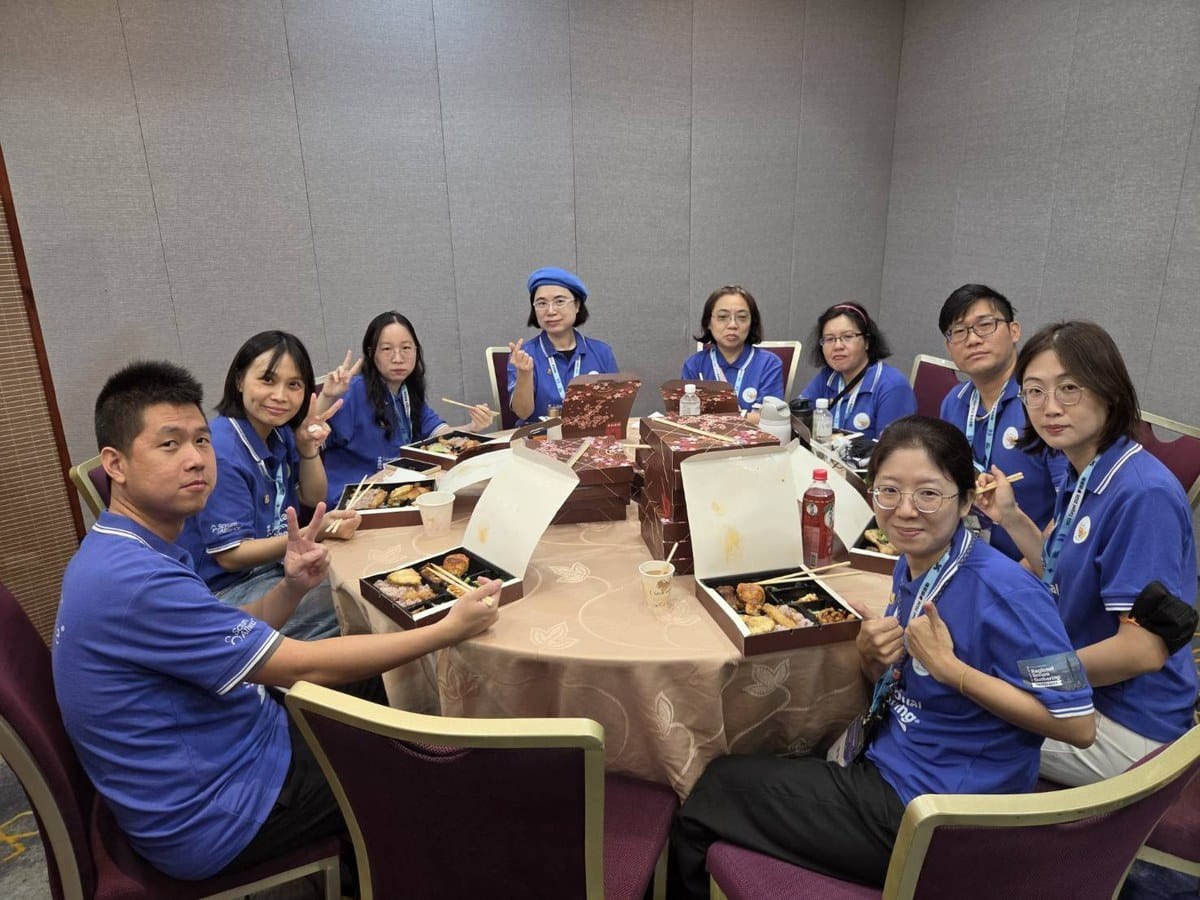
In a team that has truly internalized self-organization, the PO doesn’t need to break every single thing into a task and hand it out. This time, two pieces of work that people kept passing around long after the event ended — the voiceover for RSG’s Chinese and English promotional videos, and the gold badge every volunteer fought to pin on — weren’t anyone’s assignment. Volunteers proposed them, recruited for them, and finished them, entirely on their own.
The proposal for the video voiceover came from volunteer Liling Lee. At a Sprint meeting, she raised it herself:
“What if we gave each paragraph to a different person, so more people participate — with a reference recording so everyone stays in rhythm, showing how Scrum divides roles yet works as one.”
My only reply in the moment was: “Good proposal. PO approves — go self-organize it.” Everything after that — the recruitment chain, the recording quality standard (a Definition of Done), chasing progress, even a backup recording plan — was carried entirely by Liling Lee alone. She ultimately recruited 5 volunteers, split by section, to record both a Chinese and an English version, producing two promotional videos formally released to the public.
The badge’s story also started with a line that came up out of nowhere. Volunteer Chang Ya-chun, right after a meeting wrapped, asked in the group chat:
“After that call, could we turn this into a badge, like the ones Taiwan’s judges, military, and police wear?”
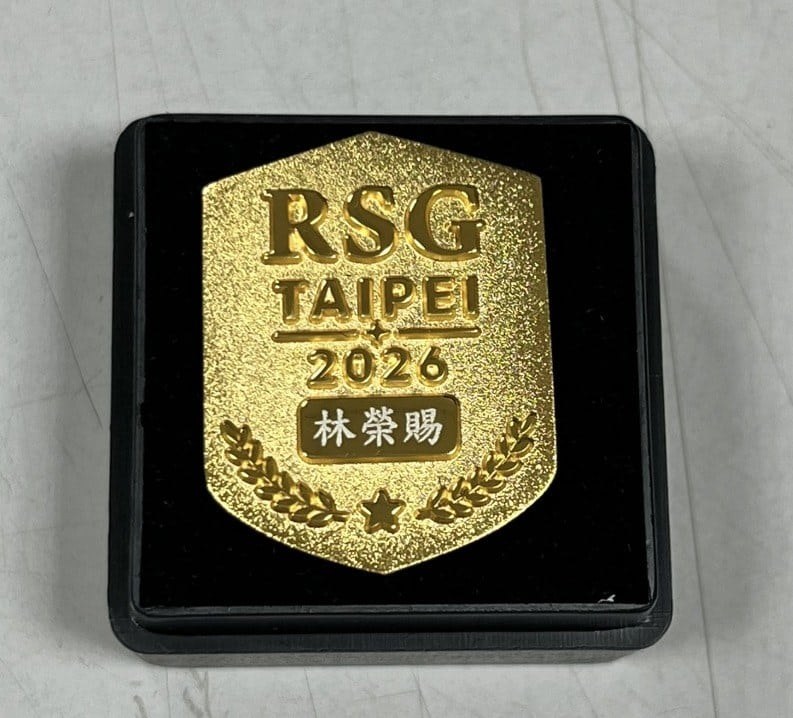
My reply set the tone for how much weight this would carry: “Great idea for a badge — something you wear all the time, a sense of honor and belonging.” From that moment, Chang Ya-chun carried the whole thing forward — the design vote, coordinating with the manufacturer on samples, proofreading every laser-engraved name character by character — ultimately producing just 118 gold-finish badges, each one engraved with the name of a specific volunteer or guest.
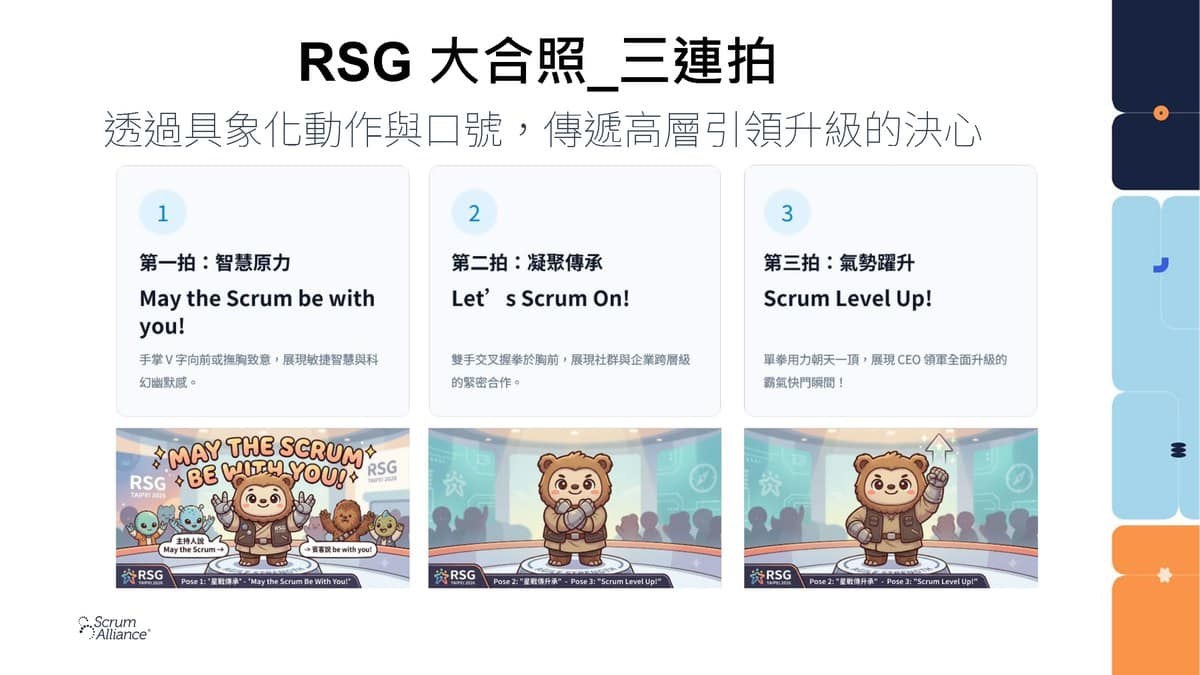
The volunteer team also designed its own group-photo format — the “triple shot” — turning the agile spirit into a moment you could actually capture with a shutter, using three physical gestures and calls: shot one, “May the Scrum be with you!”; shot two, “Let’s Scrum On!”; shot three, “Scrum Level Up!”
No one told the volunteers they could only execute tasks. Real self-organization means they get to invent the assignment itself.
8. The CEO Award Turns Four: From a One-Time Honor to a Leading Indicator
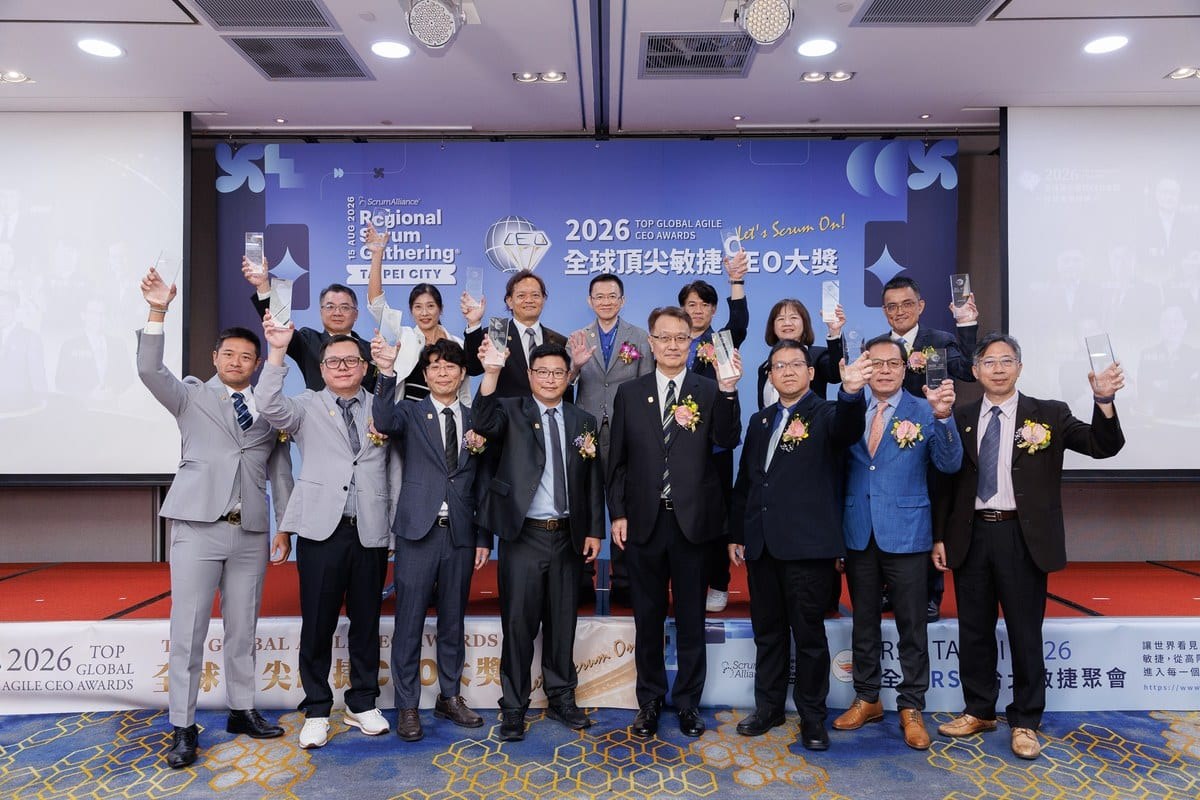
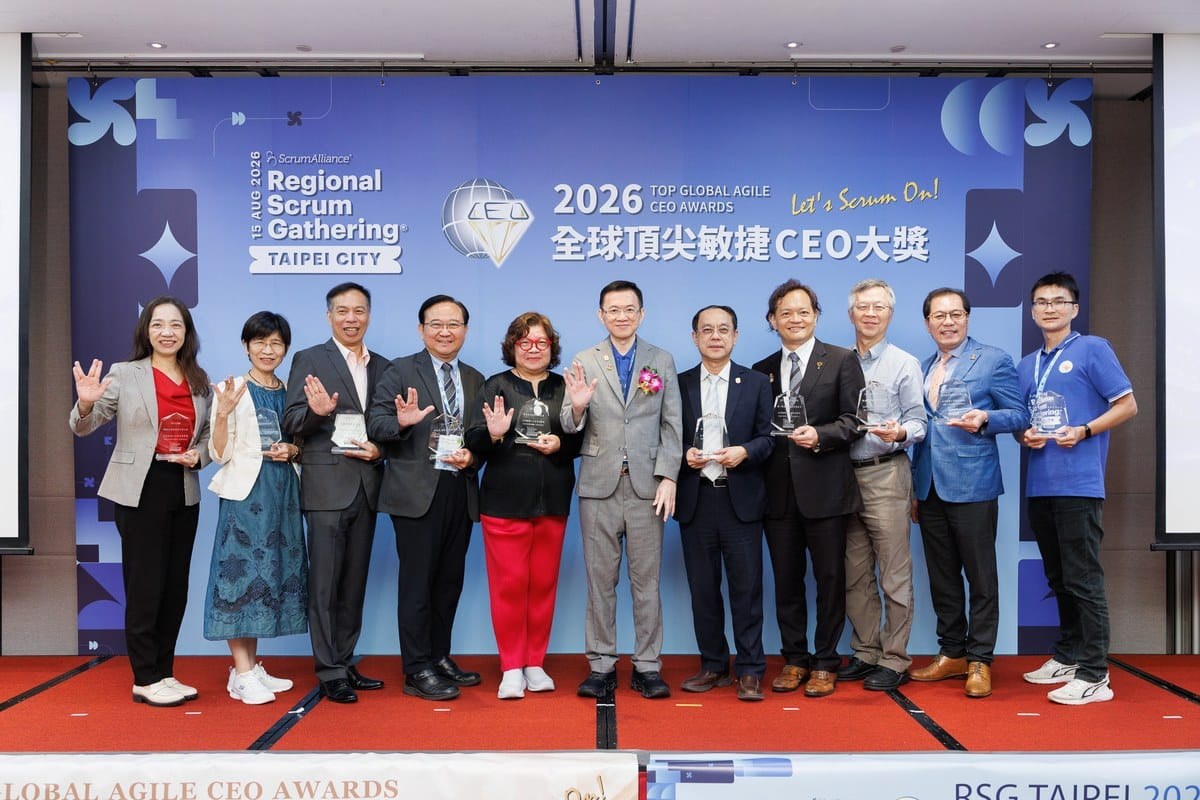
That same afternoon, the gathering also hosted the 4th Global Agile CEO Award — an award I launched in 2023, the only agile award in the world aimed specifically at CEOs and senior executives. Four editions in means this was never a one-off PR move.
This year drew 26 entries, and 10 international judges selected 14 winners: first place went to Su Wei-chuan, Chairman of Nani Book Enterprise, who led the group through a digital education transformation; second place to Yu Chun-chien, President of Galaxy Software Services Corporation (GSS), who has spent over four decades in the software industry; third place to Lo Chen-yuan, Chairman of Mason Capital, who brought agile into investment banking. The remaining 11 winners were: President Wang Hsien-tang of Guan-Cheng Energy & Environmental Control, President Lee Shih-fan of Dareying Plastics, President Chiang Chun of Lee Shinn Construction Group, COO Wang Ling-ching of Dr. Wang’s One Root, President Wu Fang-Ming of Taipei Agricultural Products Marketing Corporation, Sales Director Weng Te-chang of Pfizer Taiwan, Founder Hu Chen-hao of Auriga Security, President Hao Chen-yu of Geosense Technology, CEO Chen Mei-feng of Alltech Information System, Distinguished Professor Chen Hsing-chung of Asia University’s Information Security Research Center, and Professor Liao Yi-Ming of National University of Kaohsiung. President Wu Fang-Ming of Taipei Agricultural Products Marketing Corporation gave the most literary acceptance line of the year: “Digging with a shovel for ore, and still searching for which stone is the diamond.” Chairman Lo Chen-yuan put it more bluntly:
“I used to win awards to prove I could do it. Today I’m winning this one to prove agile can.”
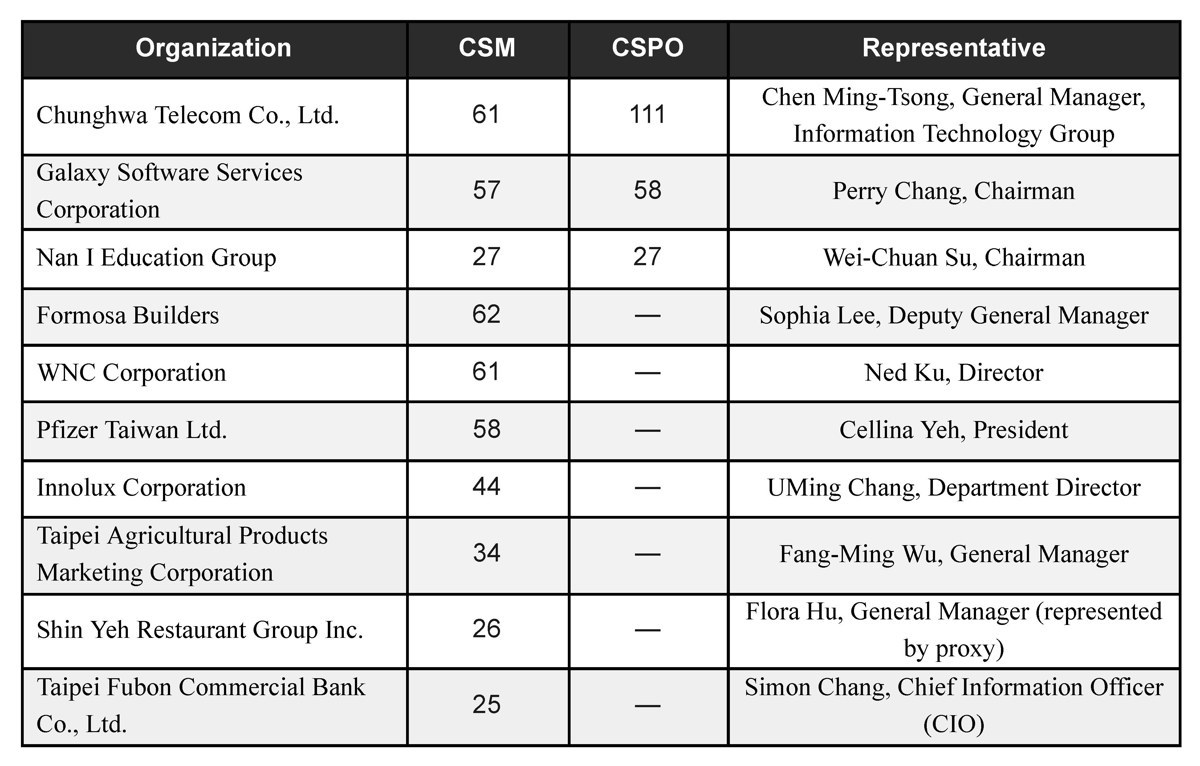
This year also introduced, for the first time, the “Corporate Agile Talent Development Award” — turning the scale of agile talent development into a leading indicator you can actually see and compare, by recognizing ten companies for their number of Scrum Alliance CSM and CSPO international certifications. Behind those numbers isn’t a contest of how many certificates a company can collect — it’s whether a company is willing to build up its talent before anyone forces it to. Enterprise agile transformation doesn’t happen overnight, and the scale of talent development is often the earliest, and most honest, signal that it’s actually underway.
9. From One Award to a Community Spanning Industries
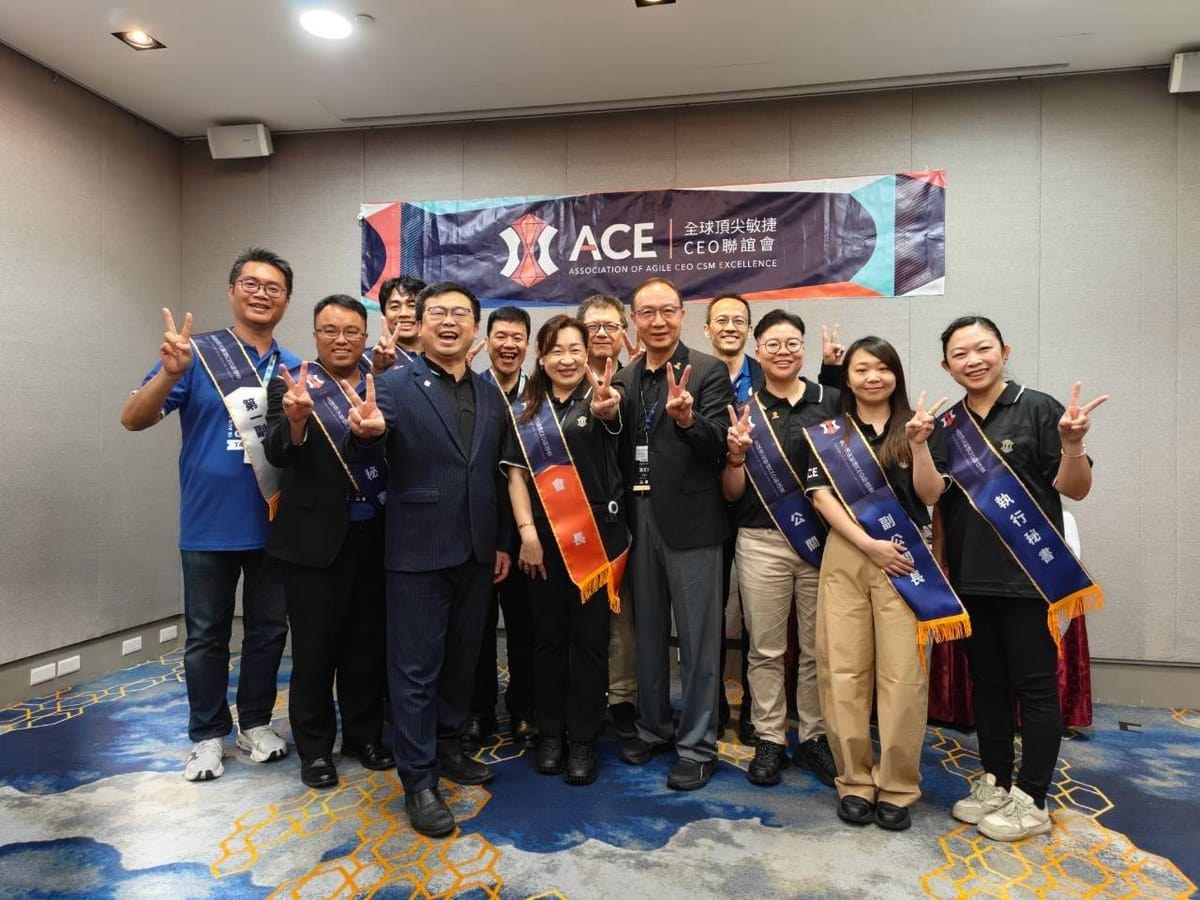
After the third year’s award ceremony, with 42 winning CEOs gathered together, Chairman Shih Chih-hsien of ASSOMA INC. stood up and called for something more: for winners to move from a “one-time award” to a “long-term journey” together. That was the starting point of the ACE Global Top Agile CEO Alumni Association, which now holds quarterly company visits, experience exchanges, and case-sharing sessions.
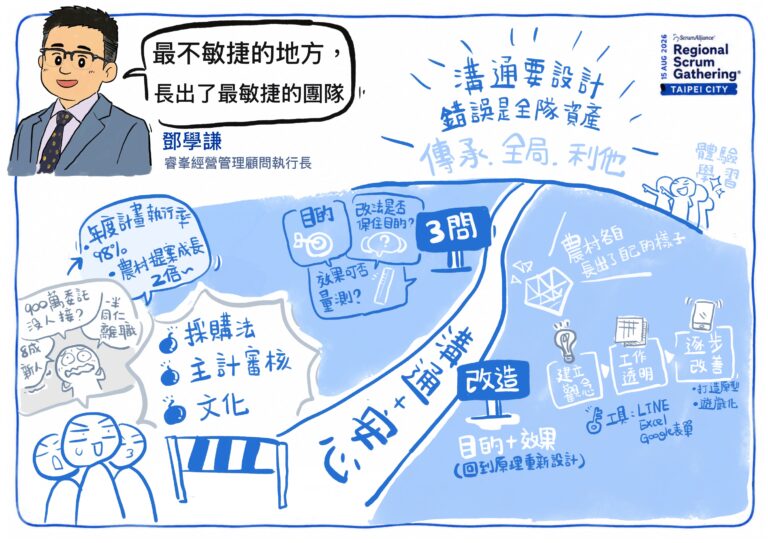
Founding president Teng Hsueh-chien didn’t come from tech — he’s a soil and water conservation engineer who has applied Scrum inside government projects and rural regeneration: “Agile isn’t the exclusive property of the tech industry. It’s a transformation capability for every industry.” Succession is already planned: the second president, Chou Chun-ju, and the third, Hu Chin-yun, have both been confirmed. At the handover ceremony, Teng Hsueh-chien passed the sash symbolizing the role to his successor, and said something with real weight:
“What this sash carries isn’t a title. It’s responsibility, trust, ownership, and honor.”
An award can expire. A community that keeps running, with a real succession mechanism, does not. That’s what RSG Taipei is actually building: not a once-a-year gathering that ends when the lights go off, but a cross-industry leadership network that keeps growing on its own.
10. What 174 Survey Responses Actually Say: This Isn’t a Slogan
Everything above, if it stopped at stories and quotes, would still only add up to “this was a great event.” What actually earns this article the right to draw a conclusion for the global Scrum community is the 174 independent surveys collected after the event — and honestly, even I paused for a second the day the numbers came in.
Overall satisfaction scored 9.27, with an NPS of roughly 71 — 75.1% promoters, only 4.0% detractors — well above the threshold considered “excellent” for international business events. Among the 51.7% who identified as management, the numbers were even higher: an NPS of about 72.2 and satisfaction of 9.36. That answers an obvious skeptical question: were the CEOs just there for show? The data says the opposite — the management tier didn’t just “show up.” They rated it higher, and engaged more deeply.
An even more telling number lands right where Scrum Alliance cares most. Of the 174 respondents, 86 held no certification of any kind, and 45.7% weren’t Scrum Alliance members — yet 99.4% said the event raised their awareness of the Scrum Alliance brand, 83.8% agreed to share their data with Scrum Alliance for marketing analysis, and 75.7% were willing to trade their data for two years of free membership. That makes RSG Taipei more than a service for the existing community — it’s a genuine membership funnel for Scrum Alliance, and one backed by data with the users’ explicit consent.
Only 38.2% were willing to contribute a deposit to support next year’s event — far lower than the 75% to 84% willing to authorize their data in exchange for membership benefits. Attendees were far more willing to invest their relationship and their data than their cash.
For any organizer trying to build a community for the long term, here’s a line worth writing down: membership benefits and content-access incentives are a far more effective lever than asking for money directly.
Closing: A Question for the Global Scrum Community
Back to the question this article really wants to ask: what happens when Scrum finally walks into the CEO’s decision room?
RSG Taipei 2026’s answer is this: scale is no longer the point — depth is. Attendance is no longer the vanity metric — the willing engagement of the decision-making layer is. Success is no longer measured by “how big was it,” but by “did anyone actually take a new way of deciding back into their boardroom” — and this time, it isn’t just the organizer saying so. 174 independent surveys and a verifiable, line-by-line record of volunteer self-organization all say the same thing.
If you’ve ever been to an RSG, or you’re weighing whether to attend the next one, this article wants to leave you with one thing to sit with: if Scrum’s next decade isn’t about “how do we make teams move faster,” but “how do we help companies make better decisions” — is your community ready?
In my work coaching companies, I keep seeing the same thing over and over: organizations aren’t short on methods. What’s never actually been aligned is the language of the decision-making layer. That’s why, in my CAF course, I never start with tools — I start with whether senior executives are willing to lay their decisions out in front of the team to see. That’s a thing that can be designed.
Roger’s Take: A lot of CEOs, after hearing the RSG Taipei story, give me the exact same line: “Roger, that’s literally our company.” My answer is always the same: then it’s time to start.
Let the world see Taiwan. Agile, starting with the C-suite, reaching into every industry.
Visit the official RSG Taipei website for the latest on next year’s gathering: https://www.rsgtaipei.org/
Additional Resources
Full Closing Report: RSG_2026ClosingReport_LetTheWorldSeeTaiwan_260819d
Closing Video: Let the World See Taiwan | RSG Taipei 2026: Agile Begins in the C-Suite
Media Coverage: RSG Taipei and the Global Top Agile CEO Award together earned 376 media placements (RSG Taipei 2026: 27 domestic, 161 international; Global Top Agile CEO Award: 28 domestic, 160 international). Full list: https://bit.ly/4cHWbuo
Speaker Slide Sharing (including graphic recording cards): Download here
Source: Roger Chou’s Blog, “This Isn’t Just Another Regional Scrum Gathering: When Scrum Walks Into the CEO’s Decision Room.” This article is the RSG Taipei official website “Latest News” adaptation, English edition.