寄送至:
rsgtaipei.tat@gmail.com
主旨:欲由XXX品牌大使推薦參與 RSG Taipei 2026


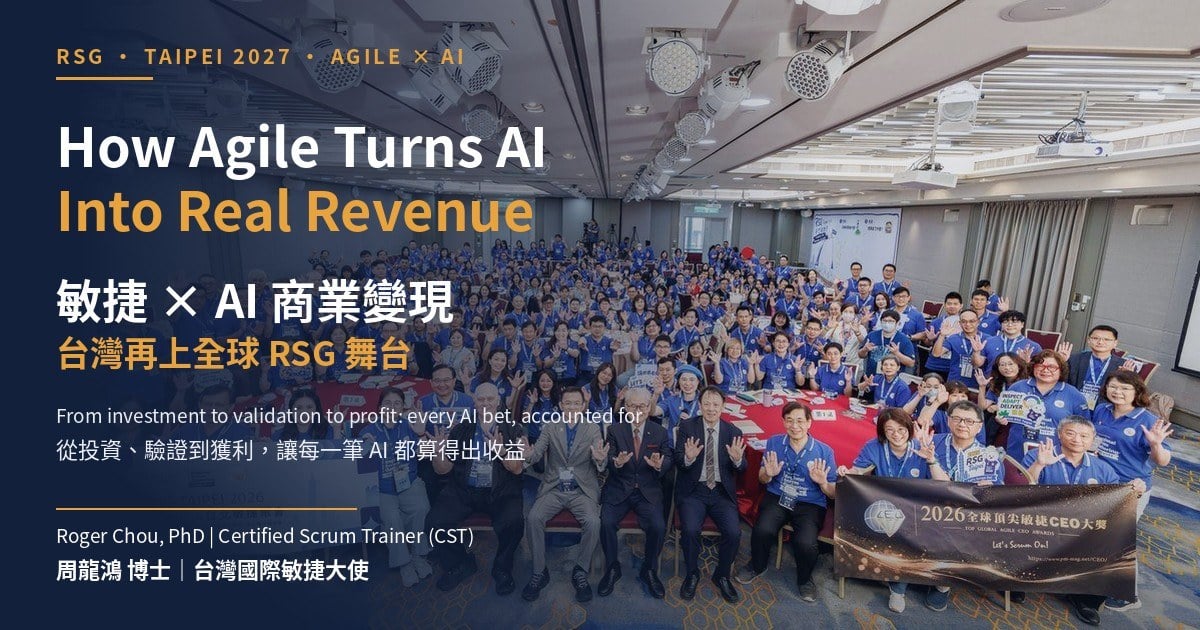
Taiwan Returns to the RSG Global Stage: Using Agile to Make Every AI Investment Pay Back
At the end of the deck, the general manager asks one question: how much did the company actually earn? RSG Taipei 2027 takes that question as its theme, using agile to make every AI investment pay back, and is set for August 14, 2027, in Taipei. Dr. Roger Chou proposes a three-gate AI Investment Decision Card, where someone at every gate has the authority to continue, adjust, or stop, along with a 0, 30, and 90-day validation rhythm after the event. Last year's closing facilitator, Larry, has agreed to return. Small-group formats and post-event support are still under discussion and not finalized.
The Costliest Mistake Is Admitting the Wrong Direction Too Late
The budget was approved, the team was formed, and the model went live. When the presentation reached its last slide, the general manager asked just one thing: “So how much did we actually earn?” The room went quiet for three seconds.
This scene does not belong to any single company. It is one Roger Chou has run into again and again over the past two years in conversations about AI with executives across industries. More and more people can write proposals and deliver demos. Fewer are willing to put the profit and loss on the table for scrutiny.
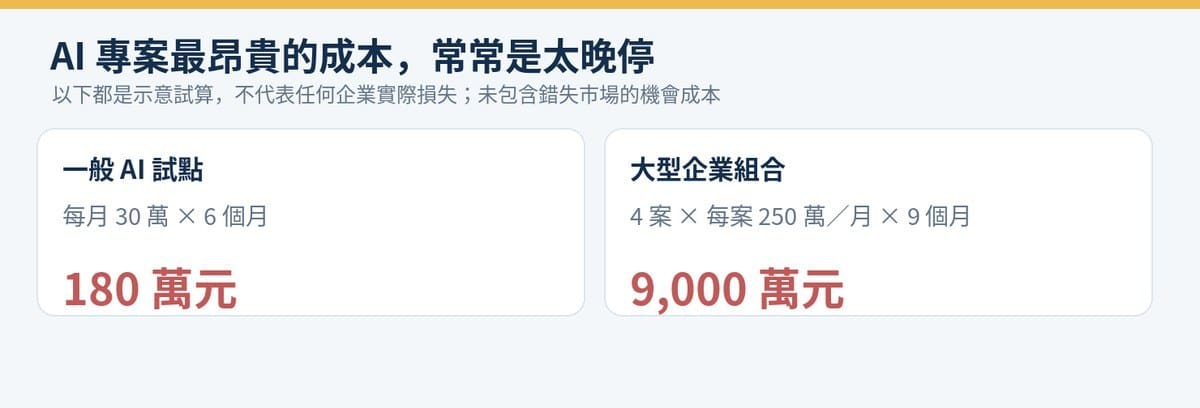
Roger Chou illustrates the point with two sample calculations, neither representing any real company. A mid-sized pilot spending NT$300,000 a month, with no one validating the core assumption for six months, costs NT$1.8 million. A large enterprise running four cross-department programs at NT$2.5 million per program per month for nine months spends NT$90 million, before counting the market window it may have missed.
The real risk in an AI project is not building one wrong feature. It is admitting the wrong direction too late.
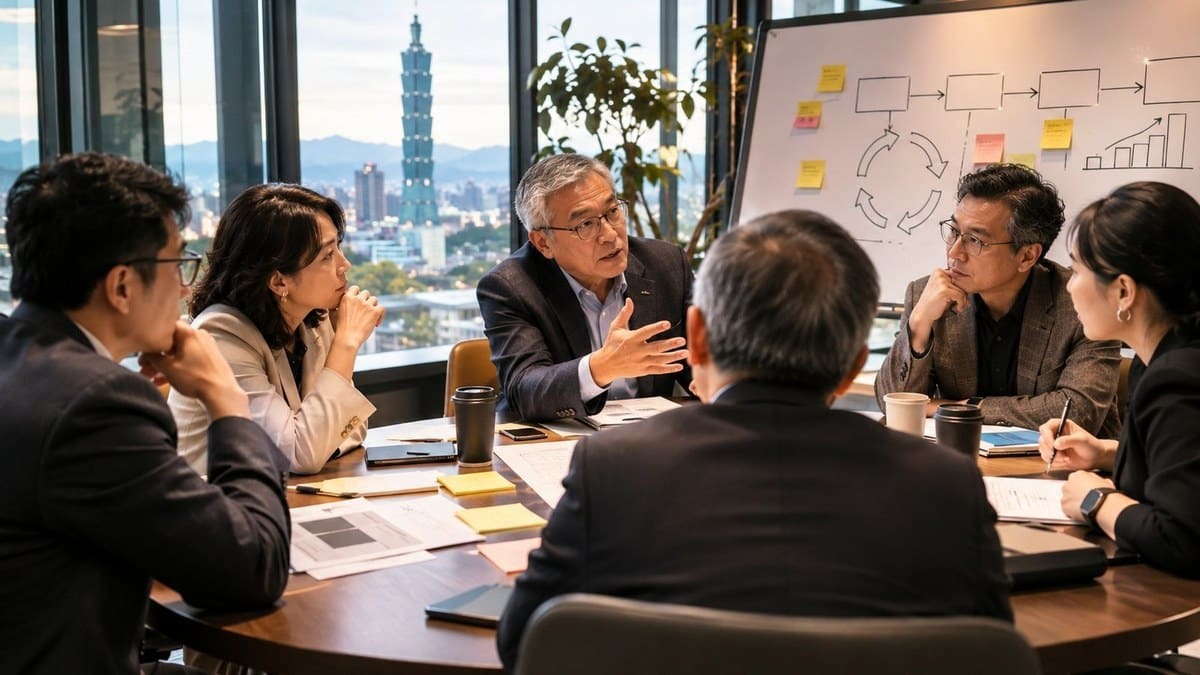
Roger Chou does not object to experimentation. What he objects to is treating a pilot as a big project that must succeed from day one. Agile lets executives go back and test their assumptions in week two and week four: Will customers actually pay? Have costs really come down? The money saved by catching a mistake early is business value too.

Hours Saved Are Not Profit Earned
Taiwan already has generative AI cases that can be examined. Kechiao Industrial (科嶠工業) used Google Workspace and Gemini, and within six months employees without an IT background built more than 60 automated workflows on their own. The company saves about 200 hours of repetitive work per month, and the efficiency of reviewing customer specifications improved by more than 70%. These figures can be measured against real processes, and they deserve recognition.
Still, Roger Chou believes business leaders must ask one more question. Once those hours are freed, what did those people do next? Did the error rate fall? Did overtime and outsourcing shrink? Did sales close one more deal as a result? Hours saved are part of the process. How much gross margin was added and how much cash came back is the ledger that leaders actually need to read.
Internationally, an AT&T case published by Google Cloud reports that overall AI return on investment rose from about 2x to 5x within a year. This is a customer case published by a vendor, not an independently audited financial report. Roger Chou cites it for one reason only: if a company has invested in AI, it should be willing to talk about returns.

One Sheet of Paper That Lets Managers Continue, Adjust, or Stop
In coaching enterprises, the question Roger Chou most often puts to managers is an ordinary one that is hard to answer: “Resources are limited. Which one thing will you do first today?”
For AI, Roger Chou turns that question into an “AI Investment Decision Card,” and every initiative has to pass three gates:
- Gate 1: Is it worth spending money to solve? Make clear who pays, what the current baseline is, and where the investment ceiling sits.
- Gate 2: Use the smallest experiment to test the assumption most likely to be wrong. Real evidence must appear within two weeks.
- Gate 3: Put revenue, cost, risk, and maintenance on the table. Work out how much money is actually left after scaling up.
At every gate, one person must have the authority to say: continue, adjust, or stop. Being able to calculate a return does not mean every initiative makes money, and stopping a wrong initiative early saves money that counts as value.
Take an AI customer service project as an example. Roger Chou would not start by asking which model to use. He would first look at the service team’s current volume and churn rate, then ask which customer behavior the project is meant to change, and finally ask whether it can truly cut avoidable cost or raise renewals. However impressive the model’s accuracy, if no one owns the business value, the project is not yet qualified to scale.
Roger Chou admits there is nothing magical about this framework. The hard part is getting the people with power to follow it, especially after the budget has already been spent.
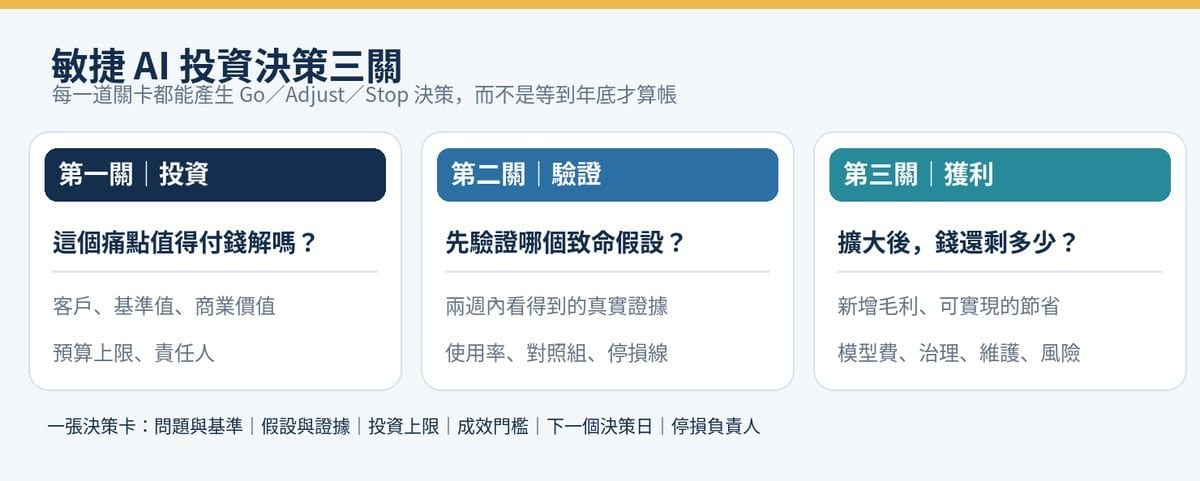
The card is not a new invention. It is the business version of the Scrum spirit. Transparency puts each initiative’s assumptions and numbers on the table so problems surface sooner. Inspection means returning in week two and week four to compare real evidence against the assumptions. Adaptation means changing direction, or simply stopping, when the evidence does not hold up. A Product Owner is accountable for business outcomes, not just for finishing the work. Scrum does not make money for a company automatically. What it can do is help a company see the evidence earlier and adapt faster.
What 2026 Left Behind Was More Than a 9.27
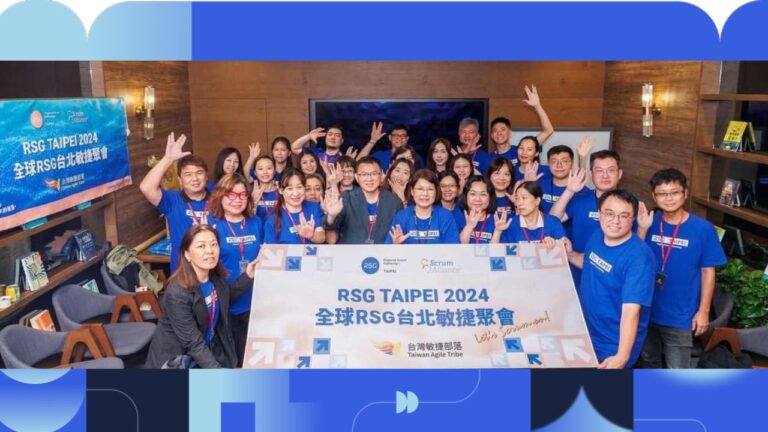
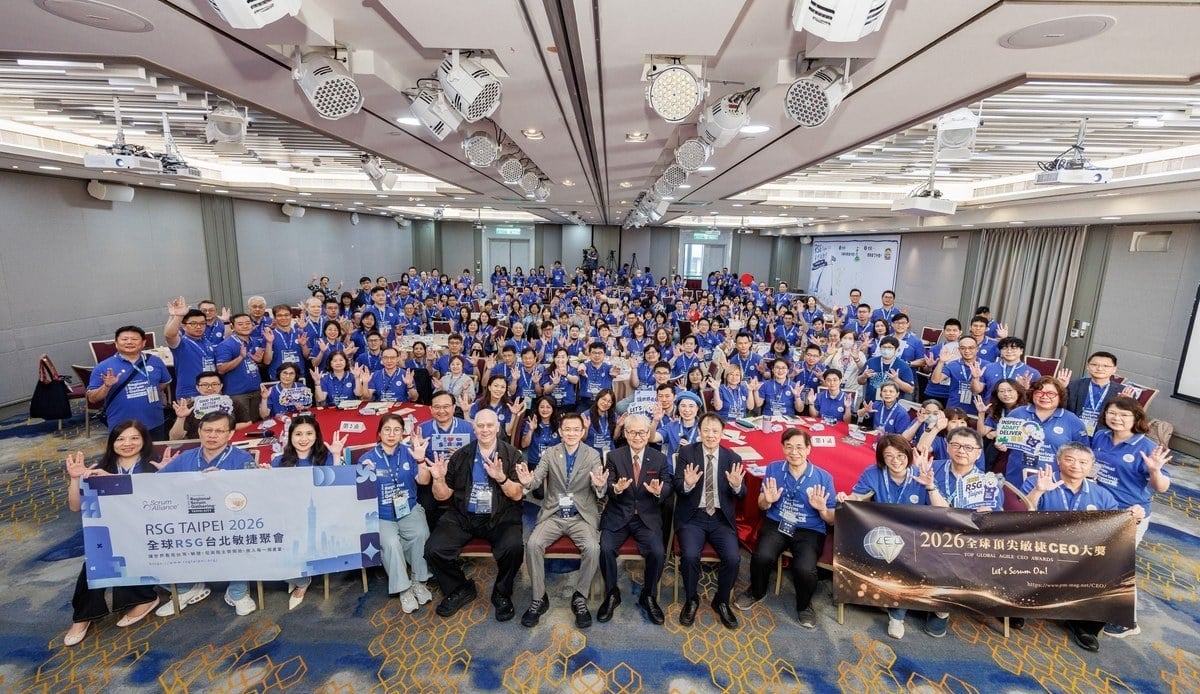
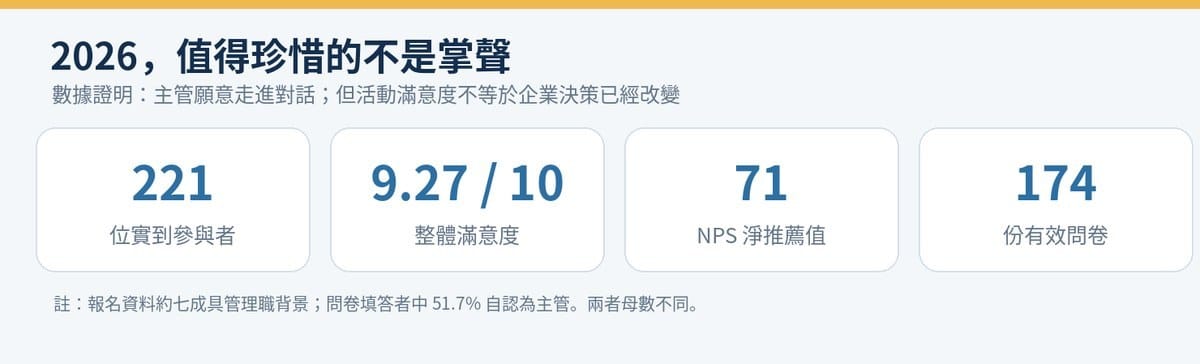
On August 15, 2026, 221 guests walked into the NTUH International Convention Center, and the theme that year was “Facilitation.” The event drew 174 valid survey responses, with an overall satisfaction score of 9.27 out of 10 and an NPS of 71. About 70% of registrants had a management background, and 51.7% of survey respondents identified themselves as managers. The two percentages have different bases and should not be read together.
Roger Chou is also the first to draw the line clearly: a high score shows that people found the day worthwhile. It does not prove that any company’s decision-making has actually changed.
What stayed with Roger Chou were other scenes. Executives set aside their titles, sat beside people from other industries, asked each other questions, and admitted there were things they did not know. 31 volunteers treated the preparation as their own. Twenty brand ambassadors stepped forward before anything had taken shape, so that more people could find their way into the room.
Roger Chou sees this as Taiwan’s strength: capable people who are willing to lift others up, and people without titles who dare to shoulder the work.
Candor Needs a Sense of Safety First
Roger Chou knows well that a general manager will not lay out orders, costs, and customer data in front of industry peers. Without a sense of safety in the room, people stick to polite talk, and however lively the event is, it never reaches the real problems.
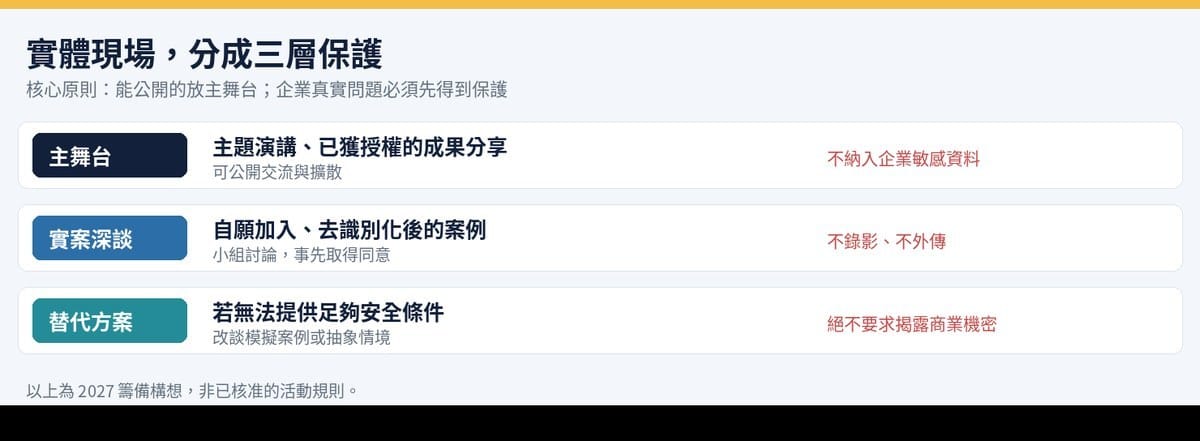
RSG Taipei 2027 is confirmed to be held in person. The on-site experience is initially planned in three layers:
- Main stage: Public keynotes and cases for which permission has been obtained.
- Deep-dive groups: Discussions of real company problems, held in small groups, de-identified, with prior consent, and with no recording and no sharing outside the room.
- Fallback: When those protections cannot be met, the group works on simulated cases instead, and no one is ever asked to disclose business secrets.
How the deep-dive groups are formed and who may join are, for now, only design ideas that must wait for formal planning to confirm. Roger Chou would rather state the boundaries first than have executives walk in with doubts.
For the Closing, the First Name That Came to Mind Was Larry
On the day it was confirmed that RSG 2027 could go ahead, the first thing Roger Chou did was send a message to Lawrence Philbrook, whom everyone calls Larry.
Larry was the closing facilitator of RSG Taipei 2026, where he guided more than two hundred executives in gathering a whole day of conversation into a next step. He is an internationally known facilitator and a member of the International Association of Facilitators (IAF) Hall of Fame. For many years he has accompanied organizations across Taiwan using the ICA’s ToP facilitation methods.
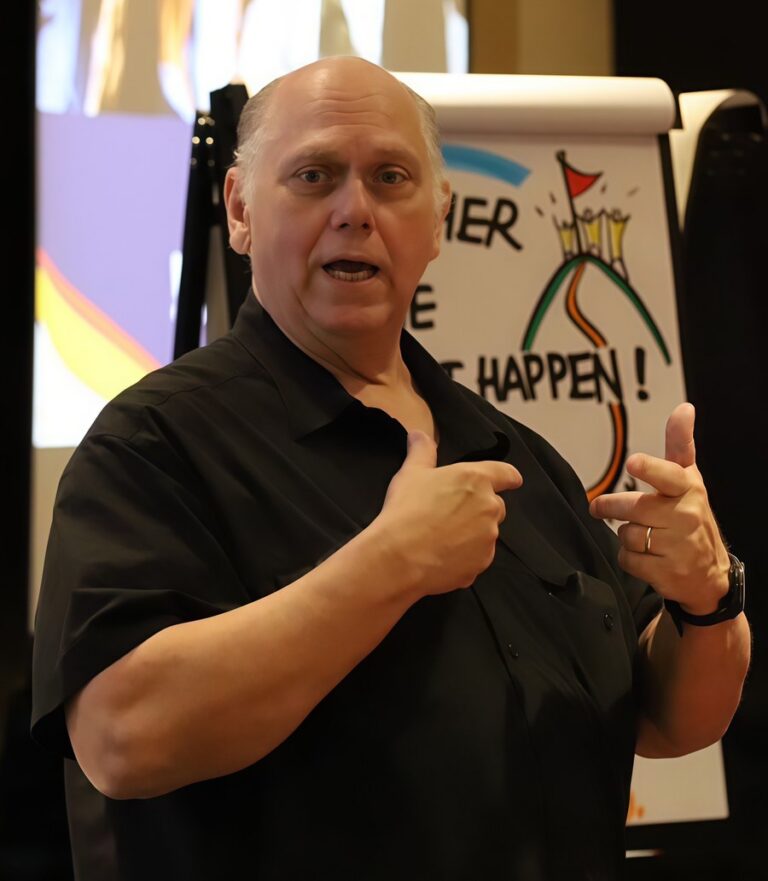
Roger Chou said it plainly: he wanted to invite Larry back for the 2027 closing. Larry has agreed, with one request: protect the closing time, so the final shared exploration has enough room. Roger Chou accepted, for a simple reason. What executives lack most is never speakers. It is time.
What the closing sets out to do is simple, though not easy. Every executive in the room answers one question: “In my business, what is one real problem where AI could make a difference? How will I know it truly helps?” During the day, facilitators first help each group think the problem through, with a few speaker talks in between. At the closing, Larry gathers the day’s discussion, and every participant takes home one idea and a first step to try back at the company.
This connects directly to the decision card. The card asks, “Should this money keep being spent?” The closing makes sure that everyone leaves with a hypothesis worth validating.
The duration, speakers, and case groups for the closing are still under discussion and not finalized. They will be announced formally once the overall plan is confirmed.
A Note to the 2026 Community: Bring One Unresolved Question
After RSG 2026 ended, Roger Chou considered taking a year off. What convinced him it was worth doing again were the people who walked the road with him in 2026.
This part is written for those who were in the room last year. Thank you for giving a whole day to a conversation that was new and deeply sincere, and thank you to the volunteers and brand ambassadors. Without them, there would be no courage to talk about a next step.
RSG invites the 2026 community to come back next year and bring, along with the memories of 2026, one business problem they truly care about. It might be costs that refuse to come down, or an AI tool the company bought that the team still does not know how to use. If possible, invite a peer who is willing to share responsibility for the outcome.
Talking about AI monetization should not turn this gathering into a sales pitch. What Roger Chou treasures most is still the trust between people that marked 2026. Speakers, facilitators, brand ambassadors, and volunteers are all co-creators he hopes will keep walking with him next year.
The Real Test Comes 90 Days After the Event
Roger Chou has a small ambition: that participants will leave with more than a circle of people they can trust, and with a decision card that actually works. On it is written the next hypothesis to validate, who is responsible, when to look back, and which number means it is time to stop.
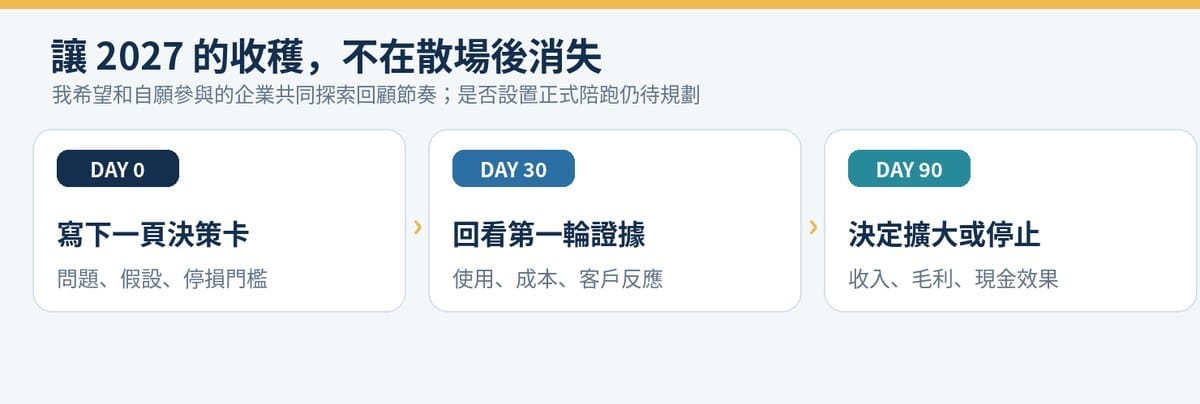
Roger Chou also hopes to pilot 30-day and 90-day reviews with companies that volunteer. At 30 days, the review looks at the evidence from the first experiment. At 90 days, it asks whether the results have turned into business metrics that can be tracked over time. This remains a design under consideration and does not mean RSG has committed to post-event consulting or fixed coaching.
What many companies lack is not more discussion, but a next step that has someone to own it, someone to call a stop, and a date. For a CEO, the heart of the question is not the model but who has the authority to hit the stop-loss button. For a business unit head, the stall they feel often comes from leadership never granting an authority to stop. Senior executives building a shared decision language is only the entry point. Every AI business hypothesis still has to be validated with data, case by case.
A company whose AI budget is already burning, and which waits until year-end to do the math, is also making a decision.
Roger Chou’s long-term goal has not changed: to accompany one hundred companies over the next ten years in bringing agile into the reality of running a business. In the age of AI, though, the real achievement is not how many certificates are issued. It is whether companies find the right customers faster, stop the wrong investments earlier, and are better placed to open new profit models.
Conclusion: After the World Saw Taiwan, What Do We Deliver?
In 2026, RSG brought agile into the executive decision room. In 2027, Roger Chou wants every AI investment to walk into that same room and face scrutiny. In 2026, people learned to let honest words be spoken. In 2027, those honest words should become next steps that can be validated.
This is not a question that needs an answer right now, but it is worth thinking through before your next executive meeting. Roger Chou hopes that one day a CEO will walk up after a session and say: “This time I finally know which initiative to back and which one to stop.” On that day, what Taiwan delivers will be more than a polished international event. It will be a management capability: facing uncertainty, admitting mistakes, and taking responsibility for results.

RSG Taipei 2027 takes place on August 14, 2027, in Taipei. Bring one question truly worth answering.
Sources and Notes
- Scrum Alliance: official list of 2027 RSG host locations
- rogersnotes.com: RSG Taipei 2026 wrap-up article, event photos, and the stories of the 20 brand ambassadors
- Kechiao Industrial (科嶠工業) generative AI adoption case (public press release, November 11, 2026)
- Google Cloud: AT&T customer case (vendor-published material, not independently audited)
All calculations in this article are illustrative and do not represent any company’s actual losses. The on-site protection design, the closing session, and the post-event validation rhythm for 2027 are planning ideas, and the closing’s duration, speakers, and case groups are still under discussion; none are finalized. Figures 1, 5, and 10 are AI-generated conceptual images, not real scenes. The figures contain Chinese text and are shared with the Chinese edition.
This is the English edition of the RSG Taipei news article 台灣再上 RSG 全球舞台:用敏捷讓 AI 的每一筆投資算得出收益. Adapted from Roger Chou’s blog: Taiwan Returns to the RSG Global Stage: Using Agile to Make Every AI Investment Pay Back.