寄送至:
rsgtaipei.tat@gmail.com
主旨:欲由XXX品牌大使推薦參與 RSG Taipei 2026


轉型式引導:ICA的參與技術
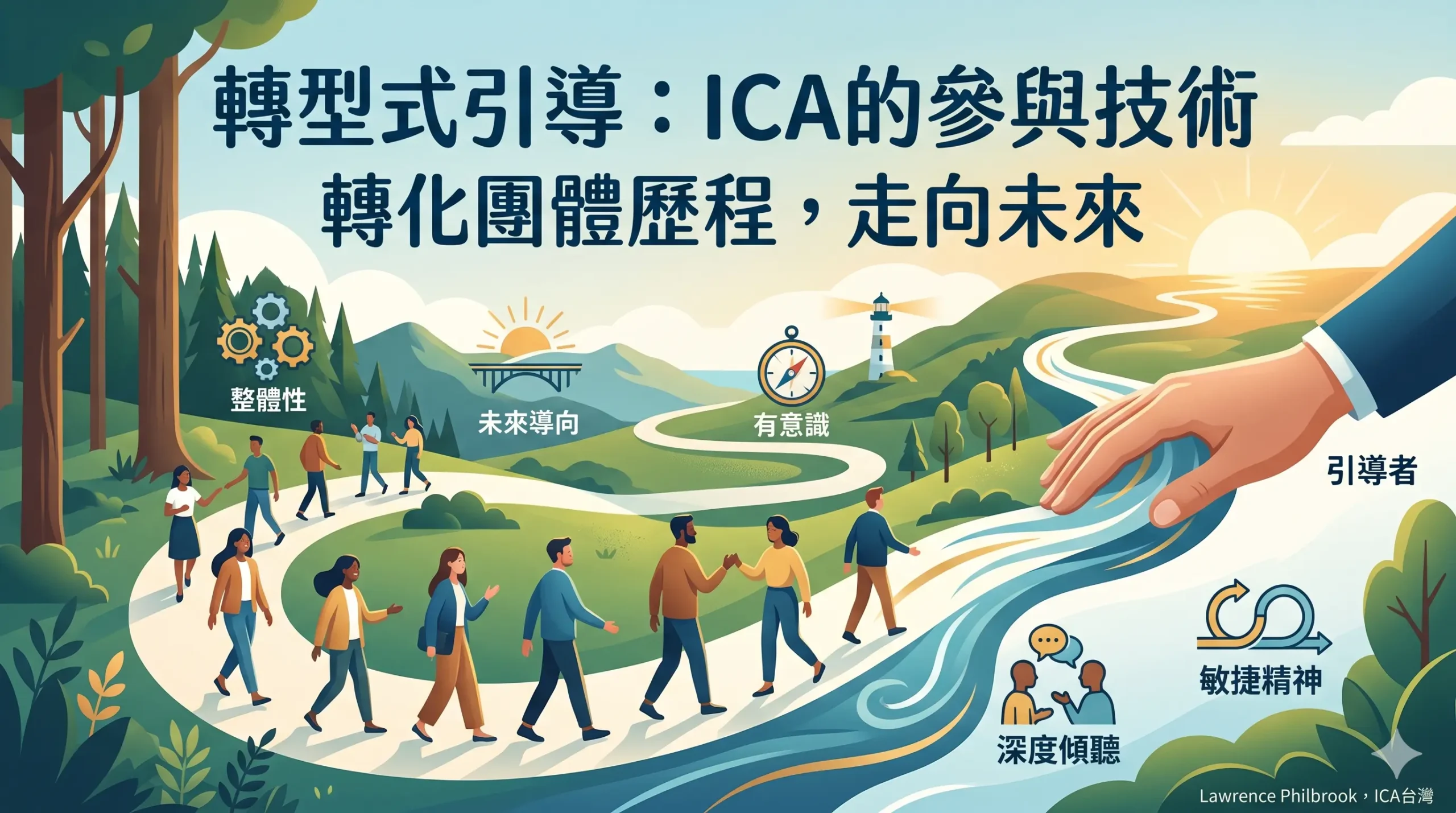
本文探討「轉型式引導」的核心精神,強調引導不應只聚焦於單一課程的「成果」,而是陪伴團體走向未來的「有意義歷程」。作者指出,稱職的引導者需具備整體性、未來導向與有意識的思維,並在與客戶合作、設計、引導及後續追蹤的各個階段中,保持敏銳覺察、好奇與同理心。
此引導模式能有效支持「青色組織」所追求的自主管理、完整自我投入與演化使命。透過深度傾聽、與客戶共同創造,並在執行後建立反思機制,轉型式引導在深層精神與尊重上,為團隊創造了安全的反思空間,進而支持組織的持續成長與長期轉變。
本文作者:Lawrence Philbrook
我最近在帶領 ToP(Technology of Participation)「形象轉化(Image Change)」課程時,與參與者一起探索到一個重要觀點:我們關注的並不只是產出某個「成果(product)」,而是在促成一段有意義的團體歷程(group journey)。這種方法重視的不只是結果,更重視體驗的意圖(experiential intent)亦即一個團體在過程中如何感受、如何成長。因此,我們會問自己:
我能做些什麼,來創造一個能支持團體所需的創造力或批判性思維的環境?
然而,要能提出這個問題,我首先必須挑戰許多領導者、教師、培訓師、教練或引導者所習慣運作的框架- 只聚焦於「這個課程」與「這個成果」。
當我進入引導(facilitation)的世界時,我是從社區發展工作開始的。在那個領域中,我們始終是在一個更大的脈絡裡進行引導:長期的、社區導向的、以參與為基礎的改變。因此,當我後來進入組織引導領域時,我也把這樣的脈絡帶了進來。
於是我問:如果我的脈絡不只是「我正在執行一個課程」,而是「我正在陪伴一個團體的歷程,陪伴他們走向今天活動之後的未來」,這樣會有差別嗎?我的答案是:會。
現在,我有一個基本假設:所有稱職的引導者,其實都在一個持續轉化的脈絡中工作。因此,引導者一方面引導眼前這個團體此時此刻的互動;另一方面也持續關注、想像並服務於更大的未來脈絡。
我認為,一位真正實踐其使命的引導者,始終是在一個我們稱之為:整體性的(Comprehensive)、未來導向的(Futuric)、以及有意識的(Intentional)脈絡中工作。
一、整體性(Comprehensive)我們不只是處理表面的任務,而是深入探究團體背後真正的需求與系統動力。
二、未來導向(Futuric)我們不只是服務當下,更是在為這個社群及其成員未來的發展而工作。
三、有意識(Intentional)我們始終以專業紀律來實踐引導工作。這種紀律並不是追求完美,而是盡自己最大的努力工作,並在犯錯時儘快修正。
很多人說:ICA,以及 ICA Taiwan 的工作方式似乎有些不同。因此,我問了這個問題:這樣的工作脈絡究竟對我的引導實踐產生了什麼影響?
首先,脈絡本身非常重要。所有工作都建立在某些基本假設,以及我們對現實的理解後,不斷演變的這些假設上。之後,脈絡的影響會發生在引導的過程幾個重要階段:
- 與客戶建立合作關係(Client Engagement)
- 設計(Design)
- 引導(Facilitation)
- 後續跟進(Follow-through)
我現在的工作脈絡是我始終假設:一個長期的改變正在展開;我正進入的是一段關係,而不只是一個專案; 個人(特別是領導者)的改變,是在過程中的一部分;以及每一次活動都是一個探索與發現的過程。
這意味著:過去有效的方法,未必適用於今天。因此,我必須保持對當下這一刻,這個系統,這群人的敏銳覺察。同時,我也假設:我會學習,我也會改變。我希望學習所有能學習的事,但我並不知道什麼才是最重要的。因此,我選擇保持好奇(Curiosity),同理(Empathy)
我早期的一位導師 Gene Marshall 最近在一封電子郵件中,提到與此相關的三種意識層面:1. 有意識地接收現實(Knowing / Attentionality)專注地覺察與理解正在發生的事。2. 有意識地覺察自己的覺察(Being / Presence)保持臨在,覺察自己的存在與意識狀態。3. 有意識地將回應付諸行動(Doing / Intentionality)以有意圖的方式採取行動與回應。這三個層面,同時存在於個人與組織之中。大約在 2014 年,我開始被邀請協助敏捷(Agile)組織進行引導工作。為了理解這種思維模式,我接觸到 Frederic Laloux 的著作《Reinventing Organizations》。書中描述的「青色組織(Teal Organization)」-一種帶有藍綠色意涵的組織形態-是一種能讓真誠、社群感、熱情與使命感蓬勃發展的工作場所。
這樣的組織需要三項核心條件:
1. 自主管理(Self-management)建立制度,使個人與團隊能夠承擔大部分決策責任。
2. 帶著完整的自己投入工作(Wholeness)建立支持反思與分享的機制,使組織與個人都能夠在決策中運用完整的自我。
3. 持續傾聽組織使命的演化(Evolutionary Purpose)對組織使命保持覺察,並建立機制,讓所有成員能持續參與與貢獻。
在陪伴團隊探索敏捷精神的過程中,我逐漸理解:轉型式引導(Transformative Facilitation)正是為此而設計的。在客戶關係中的每一個環節,其實都是一個引導時刻。
1. 建立合作關係是協作的關鍵,在於引導者與客戶之間的關係。
我們需要傾聽:真正渴望發生的改變是什麼?因此,我總是從客戶訪談開始。這不只是蒐集資料,更是與參與者建立連結、聽見多元觀點的機會。當資料蒐集完成後,還需要與贊助者(Sponsor)進行更深層的對話,以聚焦這次機會真正的意義與方向。
2. 透過深度傾聽,理解最深層的需求。並且以完整的自己投入設計工作。設計是一個持續與客戶共同創造的過程。贊助者不僅需要成為系統內的推動者(Champion),也需要理解:這項工作最終必須轉化為集體的理解與承諾。
3. 引導專注於此時此刻的這個團體。依據當下情況調整流程、方法與風格,同時保持對成果目標的關注。
4. 後續追蹤與落實。與客戶共同建立反思機制。持續觀察:
- 計畫進入行動後發生了什麼?
- 我們從中學到了什麼?
- 下一步該如何調整?
這些角色的實踐,不只是形式上的追蹤與聯繫。它們發生在更深層的傾聽與精神層次上。在那裡,有尊重,也有療癒的可能。它包括:創造安全的反思空間,面對挑戰,分享學習,支持持續成長。
Lawrence Philbrook
國際引導者協會(IAF)榮譽認證專業引導師(CPF Emeritus)
ToP 認證引導師與培訓師
Institute of Cultural Affairs Taiwan 主任(Director)
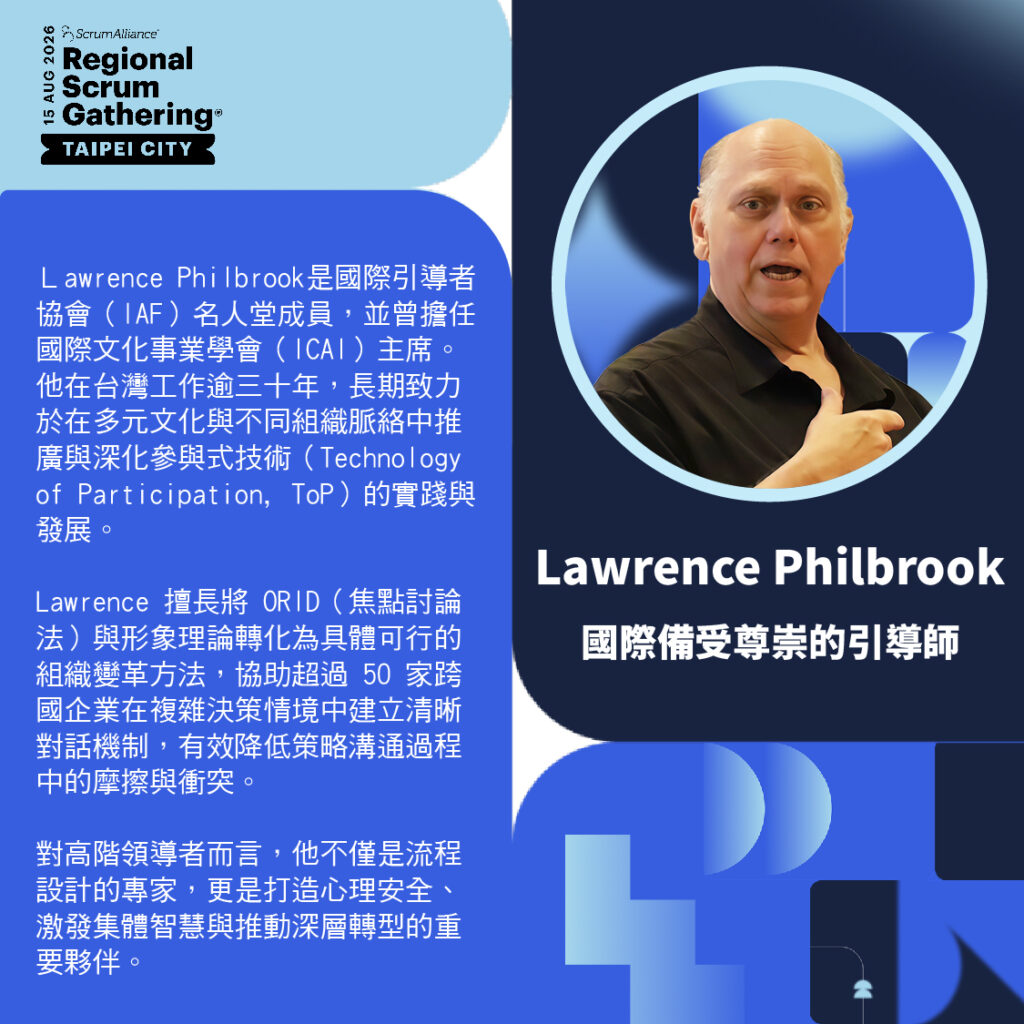
RSG Keynote Lawrence Philbrook
RSG Taipei 2026 最後保留票索票中
目前 RSG Taipei 2026 已吸引超過 180 位專業人士索票,其中超過六成為企業管理層。
如果你關心:AI 時代的組織速度、敏捷治理與企業轉型、跨產業的管理實踐——
RSG Taipei 2026 將會是一個非常難得的交流場域。歡迎前往官方網站報名:https://www.rsgtaipei.org/
Transformative Facilitation: ICA’s Technology of Participation
By Lawrence Philbrook of ICA Taiwan
My recent ToP (Technology of Participation) training on Image Change, helped me to explore with the participants that our focus is not merely producing “products” but facilitating meaningful group journeys. This approach also prioritizes experiential intent—how a group feels and grows – what can I do to create an environment that supports the creativity or critical thinking they need for their task?
To even raise this question, I first need to challenge the immediate this program and this product context many leaders, teachers, trainers, coaches or facilitators operate from. When I entered the world of facilitation, I entered it through our work in community development this meant we were always facilitating in the larger context of long-term, community-driven and participation-based change. So, as I moved into organizational facilitation I brought that context with me.
Does it make a difference if my context is I am delivering a program and facilitating a group’s process, their journey beyond today’s event?” My answer is “YES and now I have a basic assumption that all competent facilitators are operating in a continuous context of transformation and therefore are always facilitating the group at this moment while operating or imagining the larger context”
I think facilitators, if they were fulfilling their purpose, were always operating within what we called a comprehensive, futuric and intentional context.
- Comprehensive: We move beyond surface-level tasks to address the underlying needs and dynamics of the group.
- Futuric: Not only in the moment but also on behalf of the future development intended for this community and its people
- Intentional: Striving always to operate with professional discipline as a facilitator, the discipline is not about being perfect but about doing my best and correcting mistakes as quickly as possible
People have been telling me there is something different about how we work as ICA and as ICA Taiwan. So, I thought I would ask “What impact does this context have on my facilitation?”
First is the context itself, the context of the work is based on presuppositions and evolving perceptions of reality based on those assumptions, then the practice involves several important steps in any facilitative process; client engagement, design, facilitation and follow-through.
My context: I always assume a long-term change is unfolding. I assume I am entering a relationship not a program. I assume individuals especially leaders must change as part of the process and I believe each event is a discovery process implying what I have done before may not work so I need to pay attention to this moment, this system, and these people, and I assume I will learn and I will change. I want to learn everything and do not know what is most important to know so I stay curious and empathetic.
One of my early mentors, Gene Marshall, described three elements of consciousness related to this in a recent email:
- Consciously taking-in Reality (Knowing) or Attentionality
- Consciously being-aware of being conscious (Being) or Presence
- Consciously putting-forth responses into action (Doing) or Intentionality
Each of these show up at the personal and organizational level. About 2014, I was asked about working with Agile organizations and supporting them with facilitation. In trying to understand the mindset I began to explore and found Frederic Laloux, explained it very well in his book, Reinventing Organizations, describes the “teal organization” (a kind of blue green) as soulful workplaces where authenticity, community, passion and purpose thrive.
They require:
- Self-management (systems in place that support and expect individuals or teams to make most decisions);
- Bringing my whole self (structures that support reflection and sharing so that the system and an individuals have access to his/her entire self in decision making);
- and listening for the purpose as it continues to evolve (consciousness of purpose and practices that support continuous input of all members).
Working with teams and systems helping them explore what it means to be agile this is what transformative facilitation was designed each element of the client relationship is a facilitative moment.
- Key to collaboration is the relationship between facilitators and the client; listening for the deeper change desired and needed. I try to always start with client interviews, an opportunity to get diverse input while connecting with all engaged in the process. Once data is collected a deeper dialogue with the sponsor is needed to focus on this time and opportunity
- Designing through listening for the deepest level of felt need and bringing our full self to the design process the design process continues to work in collaboration with the client, they need to be the sponsor the “champion” within the system, but they also need to understand the task to shift to a collective understanding and commitment
- Facilitating with the focus on this group at this moment, adjusting your process, method and style to the moment while staying focused on the product.
- Follow up and follow through. Establishing with the client a reflective process to learn what happens when the planning moves to action and to keep adjusting based on that learning.
Playing these roles is more than just checking with the person – they take place on the level of deep listening or spirit, where there is respect and an opportunity for healing. It includes building a safe space for reflection on challenges and learnings.
Lawrence Philbrook, CPF Emeritus (IAF) and a certified ToP Facilitator and trainer, is director of the Institute of Cultural Affairs Taiwan